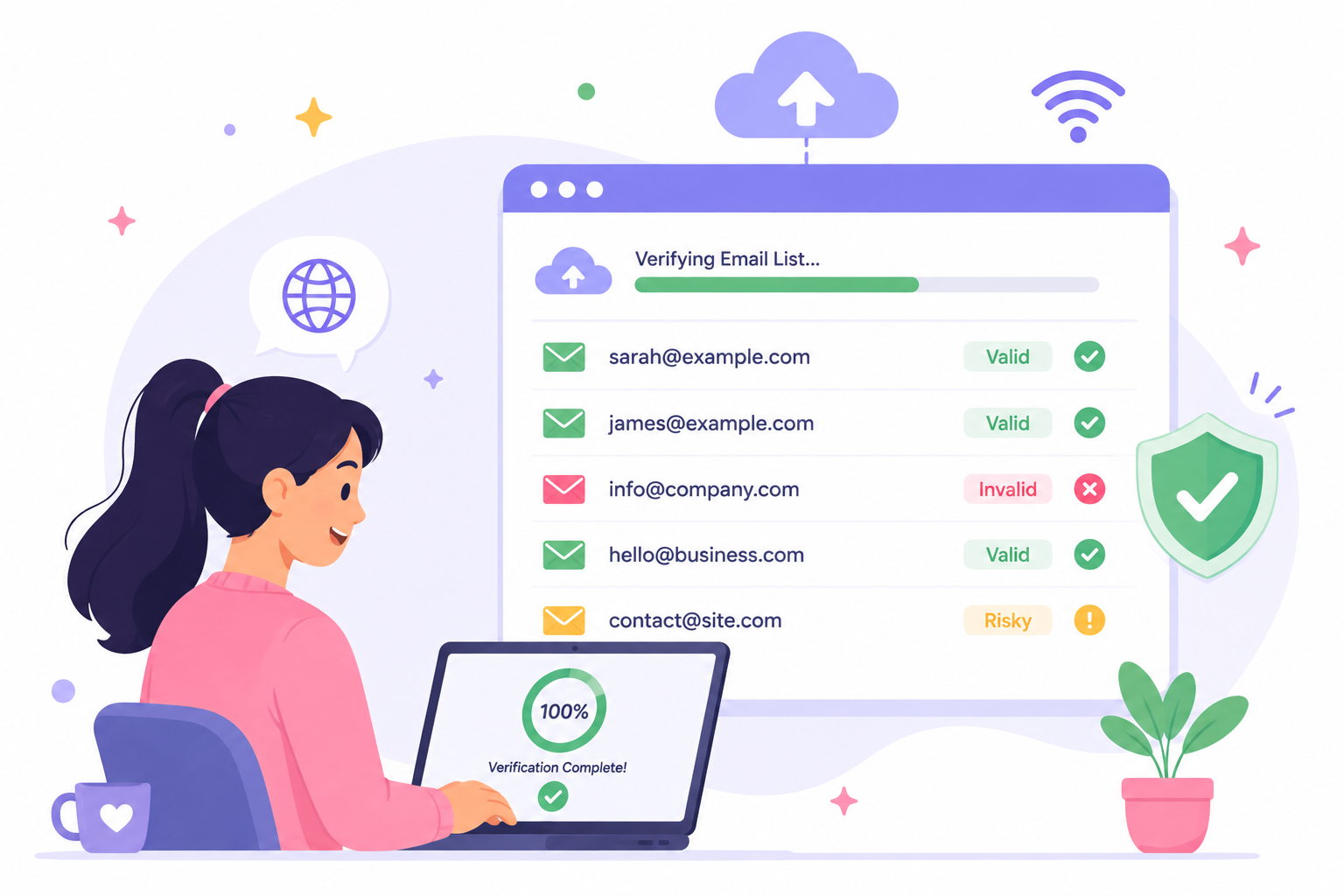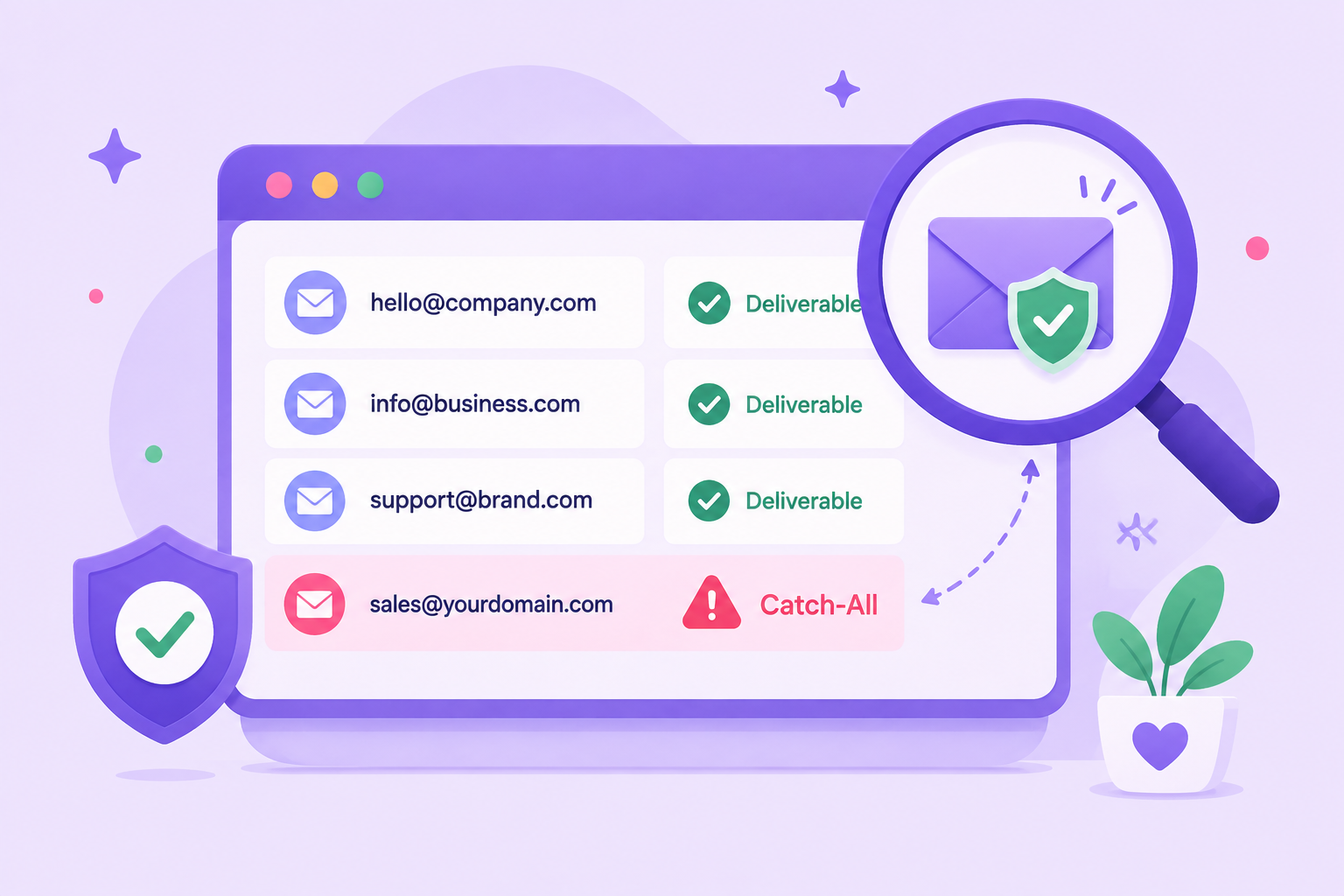
A 99% accuracy claim sounds reassuring, especially when you're preparing a large contact list or checking new leads. But what does that percentage actually tell you?
Email verification can be highly accurate, especially for checks like email format, domain information, and mailbox validation when enough information is available.
However, no verification service can guarantee 100% accuracy because email addresses change and receiving servers do not always provide complete information.
That does not mean high accuracy claims are misleading. It means they should be understood in the right context.
In this guide, you'll learn how accurate email verification tools are, which verification results are more dependable than others, what affects confidence, why verified addresses can still bounce, and how to get more reliable and current results.
Email verification accuracy refers to how accurately an email verifier identifies the current status of an email address. It reflects how closely the reported result matches the address's actual status at the time of verification.
A correct result may include:
Verification accuracy also considers incorrect classifications.
Because email verification evaluates an address at a specific point in time, every result reflects a level of confidence based on the information available during that check.
Email verification accuracy is measured by comparing a provider’s results with the known or independently evaluated status of the tested email addresses.
Providers may calculate accuracy differently depending on their testing approach. A simple formula is:
Accuracy = Correct classifications ÷ Total classifications tested
For example, if a provider correctly classifies 9,900 out of 10,000 email addresses, the reported accuracy is 99%.
The final percentage depends on several factors, including:
Published accuracy percentages should not be compared at face value because providers may use different test lists, evaluation methods, and result categories.
Bounce data can provide useful supporting evidence, but it is not a perfect measure because email delivery depends on more than email address validity.
An accuracy percentage is most meaningful when the provider explains what was tested, how correct results were determined, and which classifications were included in the calculation.
Email verification does not rely on a single check.
Instead, providers perform several verification checks, each answering a different question about an email address. Because each check confirms different information, the confidence level also varies.
The table below shows which verification checks generally provide the highest confidence and what each result establishes.
No single verification check answers every question about an email address. The most reliable results come from combining several verification checks and interpreting each result according to the level of confidence it provides.
Email verification accuracy affects the quality of the decisions businesses make before sending emails or adding contacts to their systems.
When a valid email address is correctly identified, it can remain available for future campaigns, sales outreach, and customer communication.
When an invalid email address is correctly identified, it can be removed before it reaches email campaigns, CRM records, or sales workflows.
Incorrect classifications can create different problems. One may leave unusable email addresses in the sending list, while another may remove contacts that are still able to receive email.
These decisions become even more important when businesses verify large contact databases or collect high volumes of new leads.
Even a small number of incorrect classifications can affect list quality, campaign preparation, sales outreach, CRM records, and confidence in verification decisions.
Better verification accuracy means fewer unusable email addresses stay on the sending list and fewer legitimate contacts are removed by mistake.
Two email addresses can go through the same verification process and still receive different levels of confidence.
That difference often comes from how the receiving mail server responds, how the domain is configured, and how much information is available during verification.
Mailbox-level verification depends heavily on how the receiving email server responds when a verification request is made. The server ultimately determines how much information can be confirmed about an email address.
The highest-confidence results come from an email server that clearly confirms an email address or rejects it because the mailbox does not exist. Those responses leave much less uncertainty about the verification result.
Not every server responds that way, however. Some return responses that do not confirm if an address belongs to the intended recipient, while others limit the information they disclose to help protect users and their mail infrastructure.
In these situations, a server may appear willing to accept mail without confirming that a specific mailbox actually exists. That limits how confidently a verification service can determine whether the address can receive messages.
When server responses are less direct, different verification tools may interpret the available information differently. As a result, the same email address may receive different verification results depending on how each service evaluates the response.
A catch-all domain is configured so that emails sent to unrecognized addresses can still be accepted by the domain’s mail server. Because of that behavior, the initial server response may look the same for both real and nonexistent email addresses.
This makes it more difficult for a verification service to confirm that a specific mailbox actually exists. Although additional signals can help evaluate a catch-all address, they cannot always provide the same level of confidence as a direct mailbox confirmation.
For that reason, catch-all addresses should not automatically be treated as either valid or invalid. They are often reviewed separately as risky addresses because the available information does not always support a definitive classification.
A verification result is only as reliable as the response received during the check.
Temporary conditions on the receiving server can sometimes prevent a verification service from receiving enough information to reach a confident result, even when the email address itself has not changed.
For example, an email service provider may temporarily:
In these situations, the server does not provide enough information to confidently classify the mailbox as valid or invalid.
Many verification services perform multiple tests or retry the verification to see if the temporary condition has passed. If the server still does not provide enough information, the email address may remain in a category of risky addresses.
Email verification reflects the condition of an email address when the check takes place. Even if the result is correct, it naturally becomes less current over time as email addresses change.
An email address may be deleted, disabled, or suspended after verification. Employees may leave a company, a domain may expire, or an organization may change email providers or reconfigure its mail system.
As a result, an email address that was valid during verification may later become invalid or unavailable.
This is especially common when businesses work with older contact lists or historical data. Over time, databases naturally accumulate bad addresses as employees change jobs, organizations update their email systems, and email accounts are closed or abandoned.
Maintaining accurate email data takes more than one point-in-time verification. As email addresses change, older results become less representative of what is true today.
Verification confidence also depends on how thoroughly an email address is evaluated. Not every email validation service performs the same email verification process or relies on the same verification signals before reaching a result.
For example, one email validator may only confirm the email format, email syntax, DNS records, and available mailbox-level signals.
Another tool may also identify a disposable email address, detect temporary email addresses, or evaluate additional verification signals before classifying the email address.
This is why different email validation software can reach different conclusions when they validate email addresses.
A result supported by more relevant verification evidence may carry a higher level of confidence than one based on limited information, although additional checks alone do not automatically make a result more accurate.
Email verification evaluates an email address at the time of the verification check. Sending an email is a separate event that depends on additional factors beyond the address itself.
A verified email address can still bounce if the receiving mail server rejects the message for reasons unrelated to the email address.
For example, successful delivery can also depend on:
A valid verification result lowers the risk of an address-related bounce, but it cannot guarantee that every future message will be accepted.
No. No email verification system can guarantee perfect accuracy for every email address. A verification service can only evaluate the information available at the time of the check.
Verification can become uncertain when mail servers provide limited information, catch-all configurations prevent mailbox confirmation, or temporary responses do not provide a final answer. An email address can also change after verification.
This is why published accuracy claims represent measured performance under specific conditions, not a permanent guarantee for every email address. Uncertainty is a normal part of verification whenever the available evidence does not fully support a definitive result.
A trustworthy provider explains that uncertainty openly instead of presenting every verification result as certain.
Email verification accuracy depends not only on how an email address is checked but also on how verification fits into your everyday workflow.
These practices help keep verification results more current and support more confident decisions before you send.
Email addresses change over time, so verification results become less current as the delay between verification and sending increases.
Verifying shortly before a campaign reduces the chance of relying on outdated mailbox information and helps base sending decisions on more recent verification results.
Checking an email address as soon as it is submitted through sign-up forms prevents many invalid records from entering your database in the first place.
Real-time verification works well for sign-up forms, CRM entry, sales lead capture, job applications, marketing automation tools, and marketing platforms.
An email validation API allows these systems to verify email addresses automatically before they are stored.
Older records are more likely to change over time. Employees leave companies, domains are updated, and email accounts are closed.
Rechecking older email data helps improve data quality by replacing outdated verification results with more current information.
Catch-all results should not be treated the same as confirmed valid or invalid results.
Reviewing them separately helps teams avoid mixing uncertain records with confirmed invalid addresses, making verification results easier to evaluate.
Once an email address has been confirmed as invalid, keeping it in future sends only increases the chance of address-related bounces.
Removing confirmed invalid records keeps future verification and sending decisions focused on email addresses that still have the potential to receive messages.
Hard-bounce data can identify email addresses that changed after their last verification and may justify suppressing or reviewing those records. Soft bounces should not automatically be treated as permanent invalidity because many are temporary.
Teams should also monitor their average bounce rate over time for patterns that may indicate changes in data quality. Some verification services use signals that may help identify risky records, but no process can guarantee detection of all spam traps.
The accuracy of any email verification result depends on the information available during the verification process. Listmint helps businesses interpret verification results through detailed classifications and real-time checks.
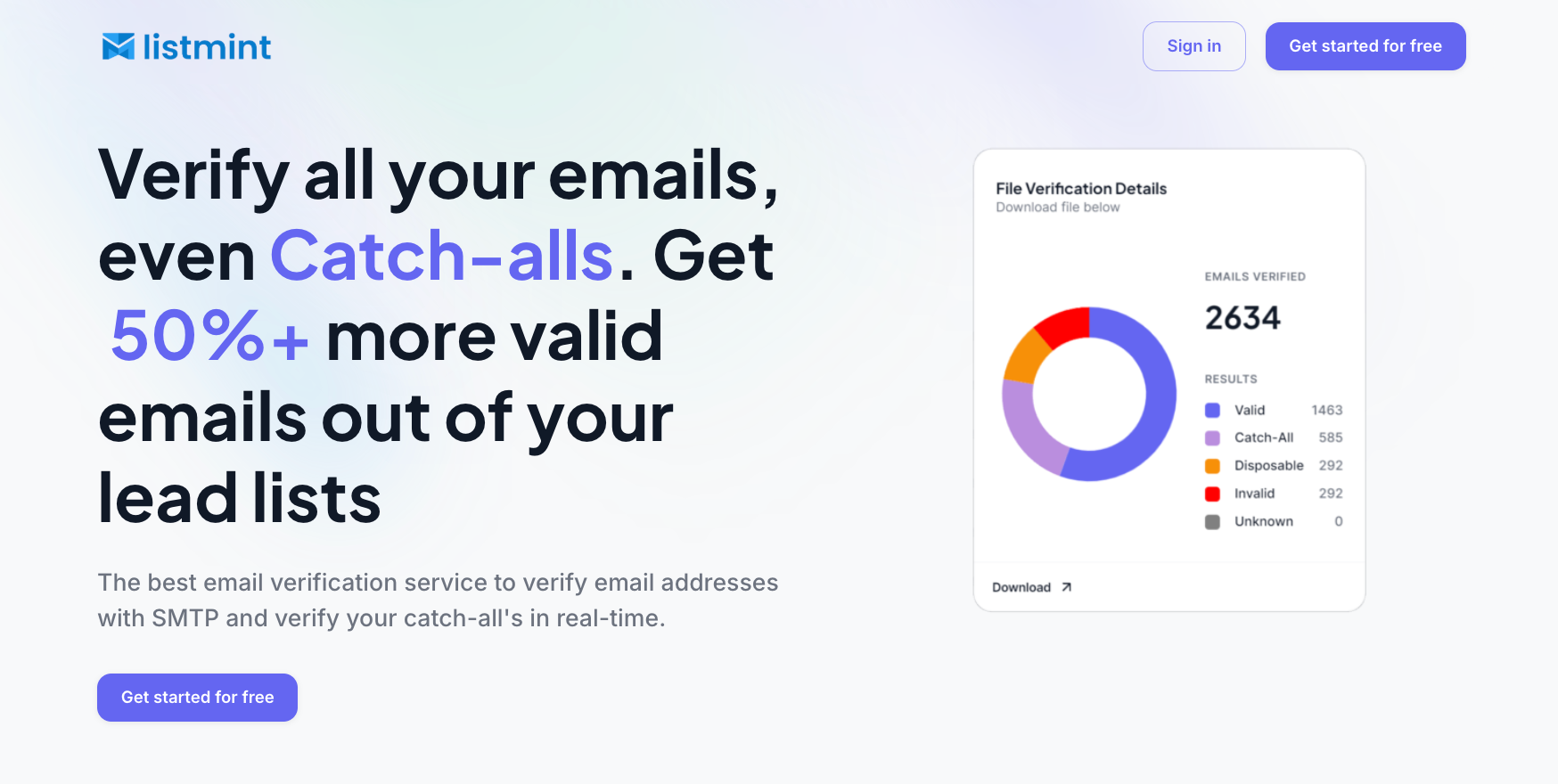
Listmint supports real-time verification for email addresses collected through forms, applications, CRMs, and sales workflows.
Checking an address as it enters your database reduces the age of the verification result and helps identify obvious invalid or malformed email addresses before they are stored.
For automated workflows, the Listmint Email Verification API allows businesses to verify email addresses as they are collected without adding manual review steps.
Catch-all domains remain one of the more difficult verification scenarios because the receiving mail server does not always confirm if a specific email address exists. A generic catch-all result can leave teams unsure how to classify an email address.
Listmint places particular emphasis on real-time catch-all verification and can return classifications such as catch_all_valid and catch_all_invalid when supported by the available verification evidence.
These categories help teams separate catch-all addresses with a more definitive result from those that remain unresolved, rather than treating every catch-all address the same.
Listmint evaluates multiple verification signals before returning a result. These include email syntax and format, domain and MX configuration, mailbox responses, disposable email address detection, role-based address detection, and catch-all analysis.
Each verification check answers a different question about an email address. Combining those signals provides a more complete assessment, although receiving server behavior can still affect the final confidence level.
Listmint returns verification statuses that help teams separate confirmed invalid email addresses from catch-all and other uncertain results. That means teams do not have to treat every email address as simply valid or invalid.
These verification outputs support more informed decisions during bulk list cleaning, form verification, CRM enrichment, and real-time sales workflows, helping businesses review, remove, or retain email addresses based on the information available at the time of verification.
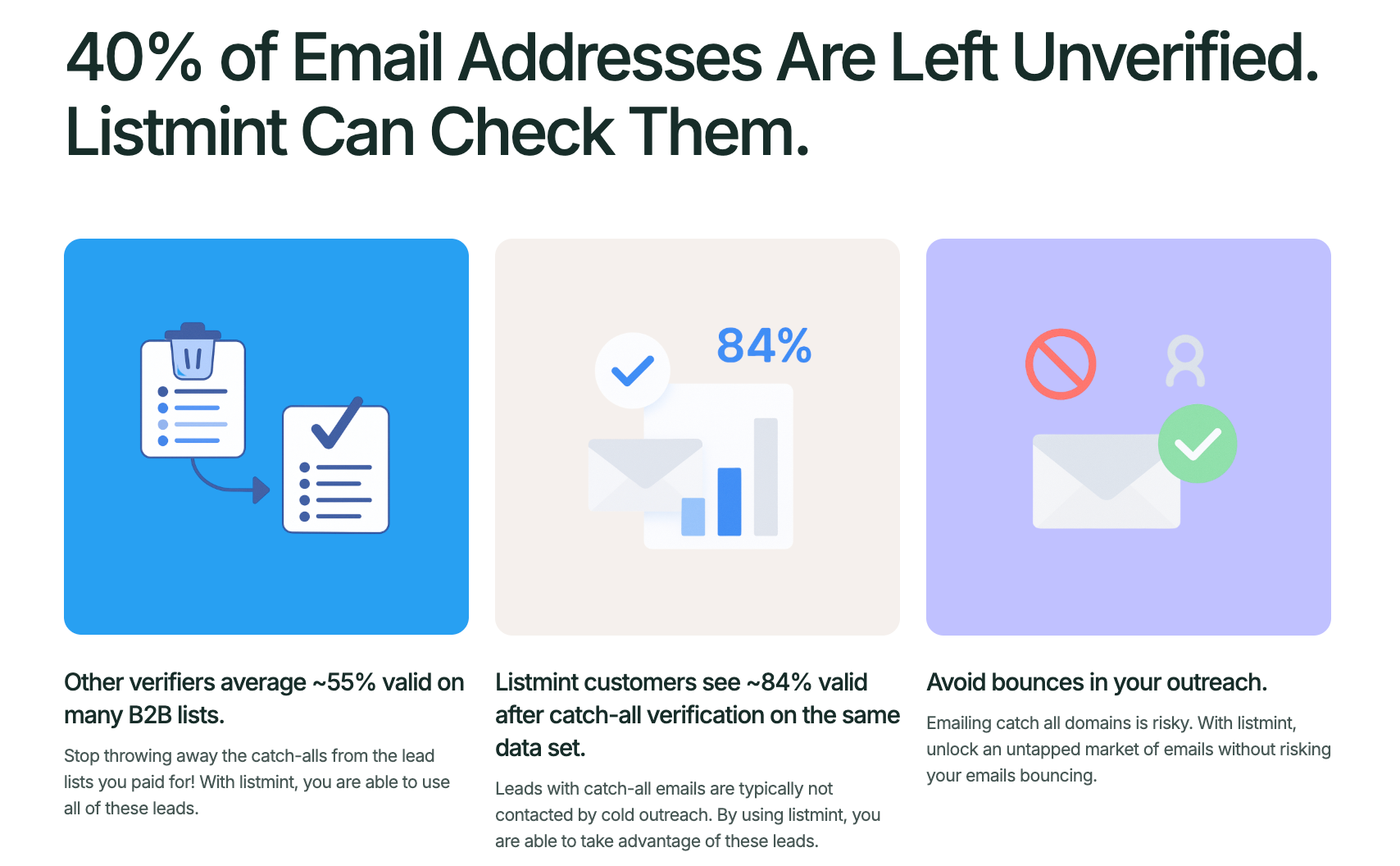
Email verification is most useful when each result gives your team enough context to decide what to keep, remove, or review. No service can remove every source of uncertainty, but current checks and more detailed classifications can support better decisions.
Listmint combines standard email verification with real-time catch-all checks and actionable result categories. It helps teams review difficult addresses without treating every result as simply valid or invalid.
Get started with Listmint for free and get clearer verification results for your email workflows.
Email verifiers can provide high-confidence results for checks such as syntax verification, domain validity, and a mailbox existence check when the receiving server provides enough information. Accuracy varies based on server responses, catch-all configurations, and how uncertain results are classified.
You can verify an email address by performing a syntax check, reviewing its domain status and DNS records, and checking the receiving server’s mailbox response. SMTP verification may also help determine if the server recognizes the mailbox.
The best email verification tool depends on your workflow, such as real-time verification, bulk list cleaning, or CRM workflows. Look for features like an email verifier API, bulk verification, detailed result categories, and support for signup forms. Listmint is the best option for businesses that need real-time verification, catch-all classification, and clearer verification results.
Email verification may return an invalid or unresolved result when the address has formatting issues, the domain cannot be validated, the mailbox cannot be confirmed, or the receiving server limits the available information. Different results can also appear when you check the same list using multiple tools or run the same tool at a different time.
Yes, you can verify emails for free with some providers. A free email checker can be useful when you only need to review a small number of addresses, but larger contact lists often need features like bulk verification or API access.