At first glance, NeverBounce vs Clearout looks like a straightforward comparison.
Both provide email verification services that help businesses prepare cleaner contact data for email campaigns, but they are designed for different workflows.
NeverBounce focuses on bulk cleaning, real-time verification, and ongoing list maintenance. Clearout combines email verification with contact discovery, enrichment, and form protection.
Some teams also consider Listmint because it brings standard SMTP verification and real-time catch-all verification together in one platform.
This comparison looks at NeverBounce, Clearout, and Listmint side by side so you can see where each platform fits best.
NeverBounce is an email verification and list-cleaning platform within ZoomInfo’s product portfolio. It is mainly used to check existing contact data before email campaigns begin and to keep records cleaner over time.
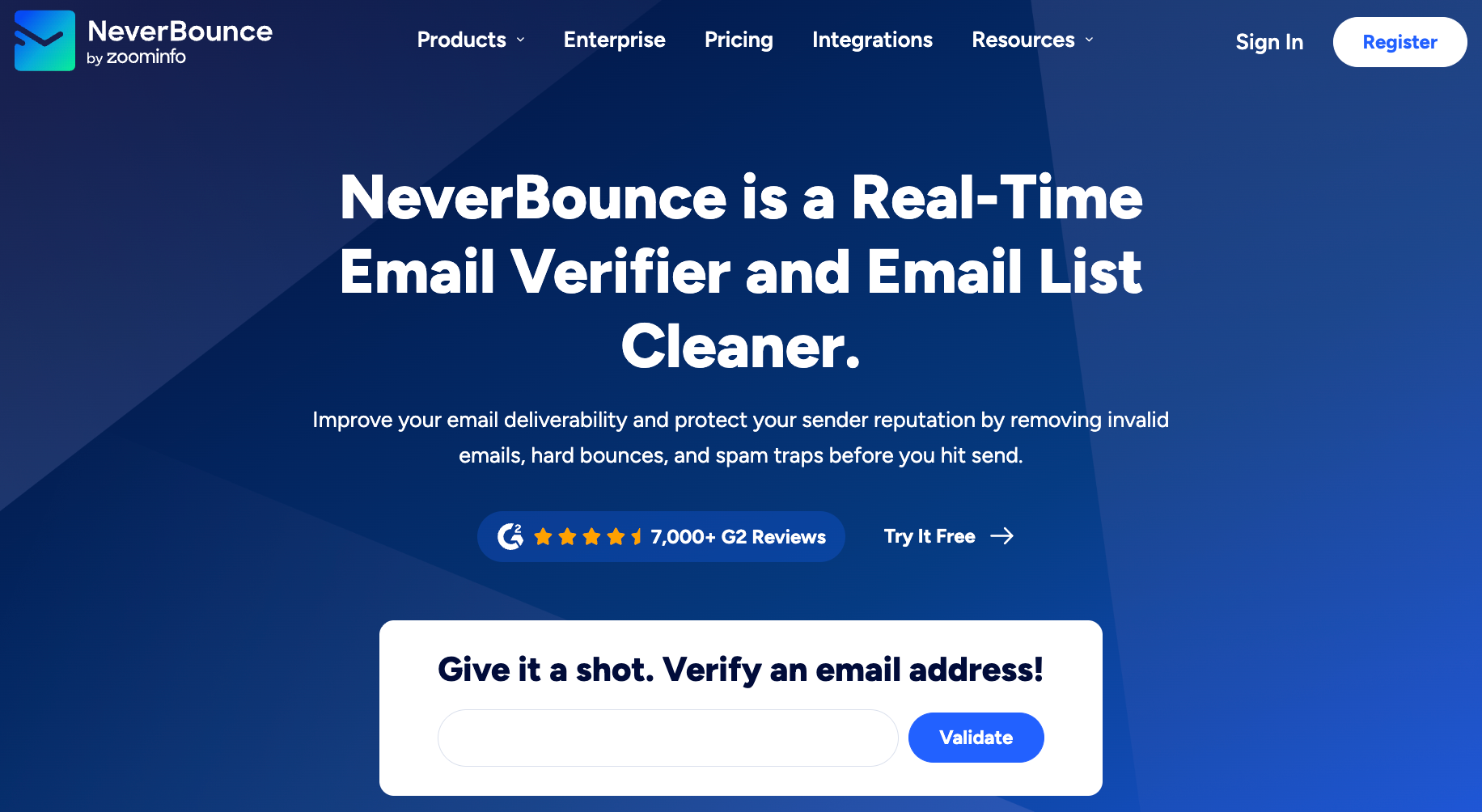
The platform supports single-email testing, bulk list cleaning, real-time verification, and automated maintenance through Sync. Its Instant Bounce Analysis feature provides an early estimate of list quality before the full cleaning process begins.
NeverBounce also supports uploaded lists, connected workflows, and API-based checks. New accounts receive free credits that can be used to test individual addresses, bulk lists, or API access before committing to a larger workflow.
The platform lists more than 80 native integrations and provides a REST API with official SDKs for Node.js, Java, .NET, and Python. These connections allow businesses to add verification to existing marketing and sales systems.
NeverBounce primarily helps maintain established email lists and an existing contact database, especially when regular cleaning is part of the workflow.
Clearout is a contact-data platform that combines email verification with lead discovery and enrichment tools. It supports both bulk and real-time validation, making it suitable for businesses that want to verify existing contact data while also finding new prospects.

Along with its email verification tools, Clearout offers an email finder feature, Form Guard, prospecting tools, phone lookup, and LinkedIn-based lead generation.
It can find contacts using names, company domains, bulk files, reverse lookup, and LinkedIn workflows, while APIs support connected verification and enrichment processes.
Form Guard validates email addresses, phone numbers, and other information entered through online forms before they reach a CRM or database.
The platform also provides browser extensions, APIs, and workflow connections that help marketing teams verify records and add data from multiple sources.
Clearout lists compliance with the GDPR, SOC 2 Type II, and ISO 27001 standards, as well as security and retention controls. These features and services support organizations that manage both existing contact records and ongoing lead generation.
Listmint is an email verification platform that combines standard SMTP checks with catch-all verification in one system. It helps businesses verify existing contact data before sending emails through bulk uploads, direct platform access, and real-time API workflows.

Standard email addresses go through SMTP verification, while addresses identified as catch-all can move to an additional verification process. Listmint then returns completed catch-all results without sending a test email to the recipient or waiting for a delayed email-based response.
Users can verify individual records through the platform or API and process larger lead lists through bulk uploads. The platform also provides API access for businesses that need verification results delivered directly into their own systems.
Listmint uses separate credits for standard and catch-all verification because the two checks follow different processes. This structure supports sales teams, marketing teams, and agencies that regularly prepare contact lists for outreach.
It can also support agencies and software providers that want to embed standard and catch-all verification into their own workflows.
Before looking at each platform in more detail, this quick comparison highlights the main differences between NeverBounce, Clearout, and Listmint.
While the table summarizes the main differences, it doesn't tell the whole story. The sections below explain these key features in more detail and show where each platform fits within the email verification workflow.
The biggest difference between these platforms appears before email verification begins.
Clearout helps marketers find new contacts through company, domain, and name-based searches. Its email finder supports individual and bulk searches, while its LinkedIn extension captures business addresses directly from professional profiles.
Clearout can also uncover phone numbers and enrich existing contact records with additional prospect information.
This makes Clearout useful earlier in the sales workflow, when teams are still building or expanding a lead database from LinkedIn, company websites, or other sources.
NeverBounce enters later. Its main focus is checking and cleaning contact data that a business already has, rather than finding new prospects.
Listmint also begins after the data has been collected or sourced. It verifies existing email lists for sales teams, marketing teams, agencies, and other businesses preparing contact data for outreach.
Email verification uses several signals to determine whether an address appears valid.
Common checks include syntax and format, domain status, MX records, mail-server responses, and mailbox-level availability. Platforms may also identify disposable accounts, role-based addresses, spam-trap indicators, and temporary or incomplete server responses that reduce confidence in a result.
NeverBounce combines these verification checks with real-time mailbox validation to identify invalid, undeliverable, disposable, role-based, and other potentially risky email addresses.
Clearout combines format, domain, mail-server, and mailbox checks with disposable email detection and AI-supported verdicts to provide additional context during verification.
When standard SMTP verification cannot fully determine the status of an address, Listmint performs additional checks on catch-all email addresses to produce a more complete result.
Reviewing several signals together supports better accuracy, lowers bounce risk, and helps protect sender reputation before your next campaign.
Bulk verification allows businesses to check existing databases by uploading a file and starting the process manually. It is useful for large email lists, older contact records, and teams that regularly work with larger lists or high volumes of data.
NeverBounce focuses on uploaded list cleaning and provides Instant Bounce Analysis before the full cleaning process begins. Users can review whether a list is ready to send, complete the verification, and download the cleaned file.
Clearout supports CSV and XLSX uploads. Its results can be downloaded and appended to the original records, which makes it easier to preserve existing contact details during export.
Listmint verifies standard addresses first. Catch-all addresses move to a separate verification stage, so additional catch-all credits are used only when needed.
This credit structure supports high-volume users without charging the higher catch-all rate for every address, while reserving the additional catch-all process for addresses that require it.
Real-time verification checks an email address as soon as it enters a business system. Common capture points include website forms, registration pages, lead capture flows, checkout, account creation, and manual CRM entry.
An API integration sends the submitted address for verification and returns an immediate response. This allows a business to flag invalid or questionable data before it becomes part of a contact database, supporting more timely follow-up and cleaner records from the start.
NeverBounce provides real-time verification for addresses collected through connected systems.
Clearout supports real-time validation at capture points and also uses Form Guard to check submitted contact information before a form is accepted.
Listmint provides immediate verification results through its API without sending an email to the address. This allows businesses to verify newly collected contacts immediately, including addresses that standard verification alone may not fully resolve.
A catch-all domain is configured to accept messages sent to any address under that domain, including mailboxes that may not exist. Because the server responds positively at the domain level, an ordinary mailbox check may remain inconclusive when verifying email addresses.
NeverBounce typically places these addresses into its standard catch-all or unverifiable classifications.
Clearout applies its Advanced Catch-All Resolver and AI-supported analysis to perform deeper checks on catch-all addresses and reduce unresolved results.
Listmint moves these results into an additional address-level catch-all verification process. It returns catch_all_valid when its verification process identifies the address as usable and catch_all_invalid when the result indicates that it should be excluded.
This creates a practical retain-or-remove decision. Teams can keep catch_all_valid addresses with their other verified contacts and exclude catch_all_invalid addresses before launching email campaigns.
Verification results help users review contact data, organize records, and understand the outcome of each verification check before an email marketing campaign.
NeverBounce provides cleaned-list results that identify valid, invalid, disposable, catch-all, unknown, and other potentially risky records. These details can be downloaded and used to prepare a cleaner sending list.
Clearout provides broader validation analysis, including deliverability classifications, confidence scores, AI verdicts, catch-all results, and downloadable reports. Users can also append the results to their original records so the existing database remains intact.
Listmint reports standard verification outcomes alongside completed catch-all results, including catch_all_valid and catch_all_invalid, giving teams a more complete view of their verification data.
Reviewing these categories can help reduce bounce risk and support better campaign planning.
APIs and integrations connect email verification with the CRM, marketing, and business software a team already uses.
NeverBounce provides a REST API with official SDKs for Node.js, Java, .NET, and Python. It also lists more than 80 integrations that support connected cleaning workflows and real-time data synchronization between business platforms.
Clearout offers a REST API, Bulk Verification API, and Email Finding API for validation and enrichment workflows. Its connections include CRMs, form tools, Google Sheets, a WordPress plugin, and a browser extension.
Clearout also highlights encryption, compliance, and other data security measures for information moving through connected systems.
Listmint provides a verification API that combines standard SMTP and catch-all verification in a single workflow. Businesses can integrate verification directly into their software, while agencies and software providers can embed or resell both standard and catch-all verification within their own products.
The API returns completed verification results immediately without sending test emails or relying on delayed verification.
Email data can become outdated after its initial verification. Mailboxes close, employees leave companies, domains expire, CRM records age, and previously valid addresses may become inactive.
NeverBounce supports recurring list maintenance through Sync. It connects with supported platforms and rechecks contact data on a schedule, reducing the need to restart each cleaning task manually.
Clearout supports ongoing validation through connected workflows, including CRM integrations, HubSpot workflows, Zapier, Make, and other automation tools. These connections can support repeated validation and contact-data updates as records enter or move through connected workflows.
Listmint supports bulk and API-based re-verification for businesses that need to review older or frequently changing contact data. This allows teams to refresh standard and catch-all results without rebuilding the entire process each time.
Regular rechecking helps keep contact databases current as older verification results become less reliable over time.
Pricing is often one of the first factors businesses compare, but the starting price does not always tell the full story. Monthly plans, subscription models, credit systems, usage limits, and enterprise options can all affect the total cost over time.
This section compares the current pricing structures for NeverBounce, Clearout, and Listmint so you can see how each platform organizes its plans.

NeverBounce also provides free list analysis and free test credits for new users.

Clearout also offers one-time pay-as-you-go credits and additional subscription tiers beyond Pro 10K.
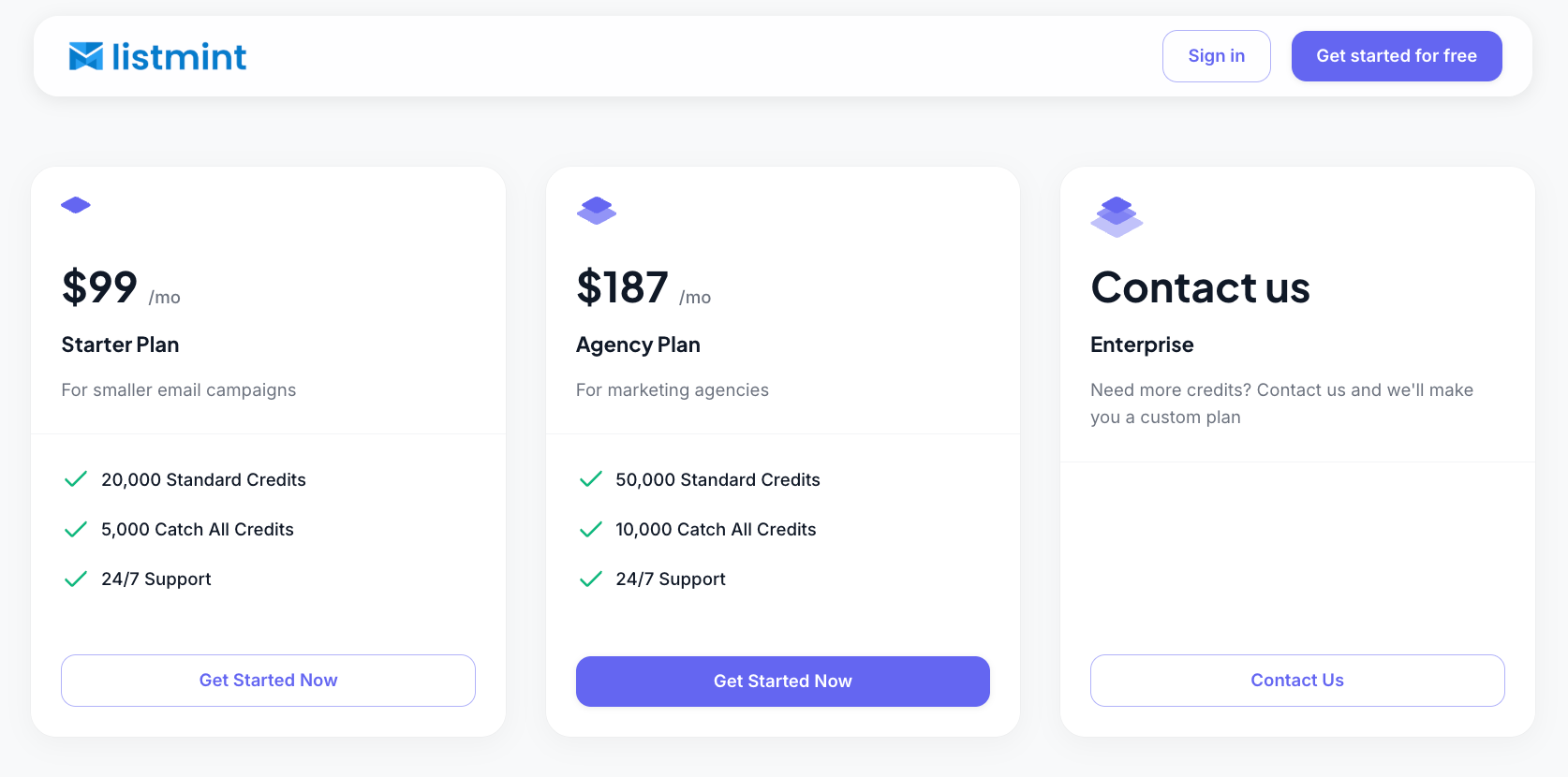
Unlike the other platforms, Listmint separates standard verification credits from catch-all verification credits, allowing businesses to use catch-all verification only for addresses that require those additional checks.
Choosing the right platform depends on where email verification fits into your workflow. Some teams need to maintain existing contact databases, others need to build new prospect lists, and some need more complete verification for both standard and catch-all email addresses.
Choose NeverBounce if your team primarily works with contact lists you already own and wants to keep them clean over time.
It is a good fit if you:
NeverBounce is a practical choice for teams that prioritize ongoing list cleaning, automated maintenance, and connections with existing CRM and marketing systems.
Choose Clearout if lead generation begins before email verification and your team needs to find new contacts.
It is a good fit if you:
Clearout is designed for businesses that combine prospecting and verification within the same workflow.
Choose Listmint if your team needs more complete verification for standard and catch-all email addresses.
It is a good fit if you:
For businesses where NeverBounce accuracy or other standard verification methods still leave catch-all addresses unresolved, Listmint extends the verification process to produce completed catch_all_valid and catch_all_invalid results.
This makes Listmint well suited to teams that rely on both standard and catch-all verification, especially agencies, sales teams, and software providers that need clearer verification results as part of larger B2B data and outreach operations.
Standard SMTP verification can leave some catch-all addresses unresolved, giving teams less certainty about which contacts to keep. When a standard check cannot confirm a catch-all mailbox, the address may remain in a catch-all, unknown, or risk-based category.
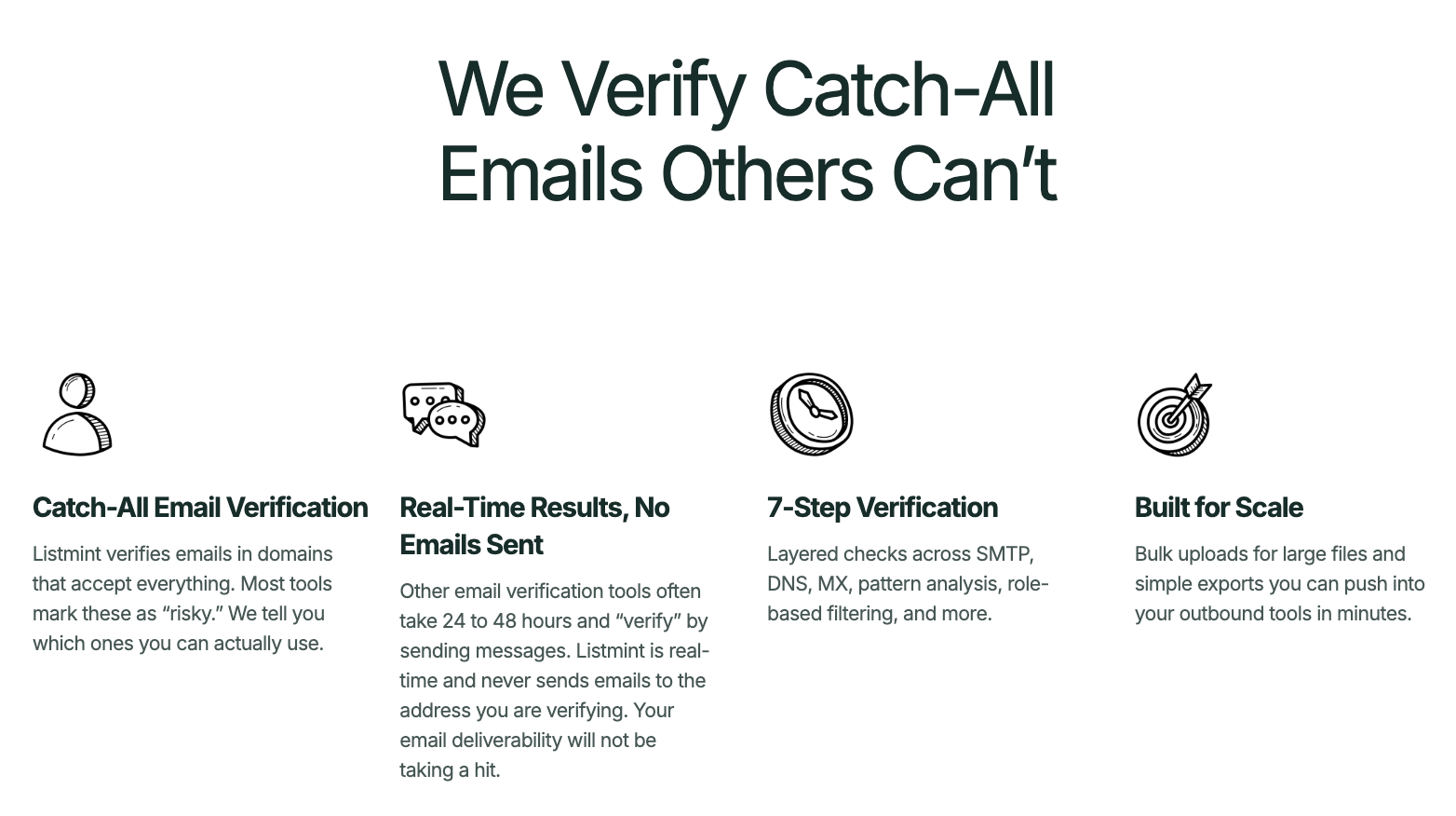
Listmint continues verification for those addresses, returning completed results without sending test emails. Trusted by businesses that have verified more than 1 billion email addresses, the platform helps teams review more contacts with greater confidence before email campaigns.
Every email begins with standard SMTP verification. When a catch-all address requires additional verification, Listmint automatically continues the process until a completed result is available.
The workflow includes:
Listmint uses separate credit pools for standard and catch-all verification. Catch-all credits are only consumed when an address requires additional verification.
Verification results are delivered in real time without sending test emails or relying on delayed email-based verification.
These capabilities are available through both the Listmint platform and its API, making it easy to verify email addresses during everyday activities, including:
Completed catch-all verification gives teams clearer information when reviewing contact lists.
Addresses returned as catch_all_valid can remain alongside other verified contacts, while catch_all_invalid results can be removed before campaigns begin.
This allows businesses to make sending decisions without keeping verified catch-all addresses in a separate unresolved segment.
Listmint supports businesses verifying their own contact lists as well as agencies and software providers that need verification built directly into their products.
Its real-time API allows organizations to integrate verification into internal workflows or embed verification within customer-facing applications. Businesses can also resell Listmint's verification services as part of their own offerings.
Listmint brings direct verification, API access, and dedicated catch-all verification together in one platform, giving businesses a single place to verify email addresses.
NeverBounce is a solid choice for businesses that primarily need ongoing email list cleaning and maintenance. Clearout is a better fit for teams that want to combine email verification with contact lookup, enrichment, and list-building.
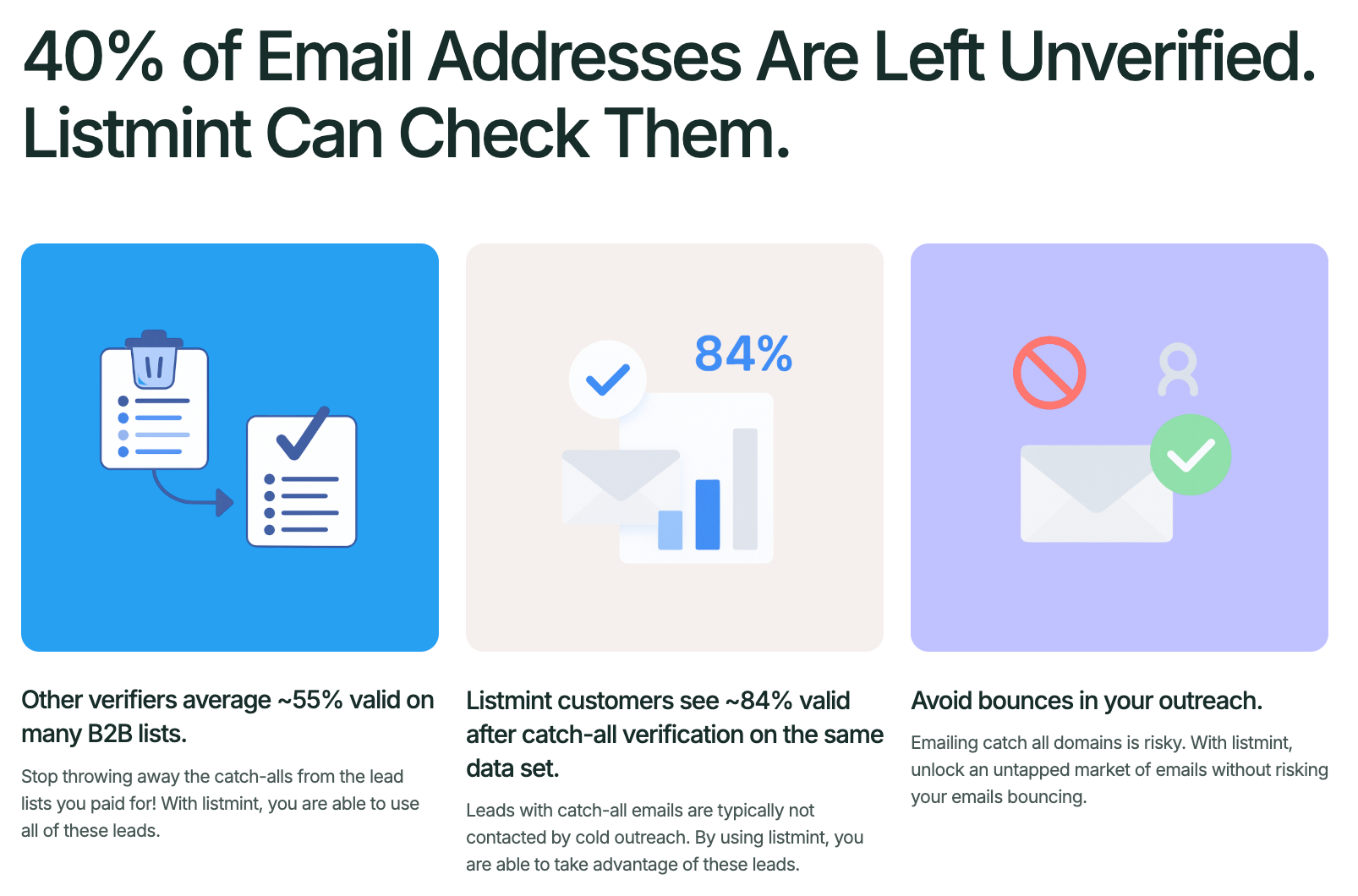
If your priority is comprehensive verification for standard and catch-all email addresses on a single platform, Listmint offers a more specialized approach. Listmint returns completed catch_all_valid and catch_all_invalid results without sending test emails.
Whether you're verifying uploaded contact lists, checking new leads through an API, or embedding verification into your own software, Listmint provides a simpler way to verify email data before outreach.
Verify your email lists with Listmint and get started for free today!
Yes. Clearout is a legitimate email verification platform that also provides contact search, enrichment, and form validation. It supports bulk and real-time verification, APIs, integrations, and prospecting tools for sales and marketing teams.
Yes, if your priority is verifying and maintaining existing email lists. NeverBounce is well suited to small businesses and larger organizations that need bulk verification, real-time verification, ongoing list cleaning, and CRM integrations. If you also need dedicated catch-all verification or contact-finding tools, another platform may be a better fit.
The best NeverBounce alternative depends on your workflow. Clearout combines email verification with contact discovery and enrichment. Listmint is a good choice for businesses that need standard SMTP verification together with dedicated real-time catch-all verification.
The best mail tester is one that helps reduce bounce rates by identifying invalid and risky email addresses before you send a campaign. Look for a platform that performs syntax, domain, SMTP, and mailbox checks. If catch-all domains are common in your lists, dedicated catch-all verification can also be valuable.
Yes. Verifying email addresses before sending campaigns helps remove invalid or undeliverable contacts, which can reduce bounce rates and improve deliverability. Cleaner contact data also helps businesses maintain healthier sending lists over time.