Clearout is an email verification service used to check email addresses, clean lists, and support lead generation through tools like email verification, bulk checks, an email finder, and API access.
But as your business grows, your verification needs can change. You may need better catch-all handling, clearer pricing, stronger integrations, faster checks, or a workflow that fits how your team collects and verifies leads.
That is why many businesses compare Clearout alternatives before choosing their next email verification tool.
This guide breaks down the top options so you can find an alternative to Clearout that fits your workflow, budget, and email quality goals.
These are the six best Clearout alternatives in 2026:

Clearout is an email verification platform that helps organizations verify email addresses before sending campaigns or adding contacts to their CRM. It also includes an email finder, bulk verification, an API, and tools for validating email addresses as they are collected.
Beyond email verification, Clearout offers LinkedIn prospecting, its Form Guard real-time form validation tool, Google Sheets integration, a WordPress plugin, and bulk list uploads.
For teams that regularly build and clean contact lists, having these tools together can make the process much easier to manage.
Businesses usually start comparing email verification platforms after their workflow changes.
Email addresses often come from web forms, customer relationship management (CRM) system imports, prospecting tools, and marketing campaigns.
Bringing all those contacts together can also introduce invalid email addresses and other bad data, especially when the same data exists in multiple systems, which lowers overall list quality.
Budget often comes into the conversation, too. Verifying email addresses regularly usually requires more credits, and extra services can increase the total cost.
The way a business works can also influence the decision. An agency cleaning prospect list has different priorities from a company validating signup forms or checking new contacts before they enter a CRM.
Those day-to-day differences are often what lead businesses to compare alternatives.
Choosing an email verification platform isn't just about picking the one with the longest feature list. The better fit usually comes down to how your team works, the size of your email lists, and the type of verification you need most.
The tools below each take a slightly different approach.
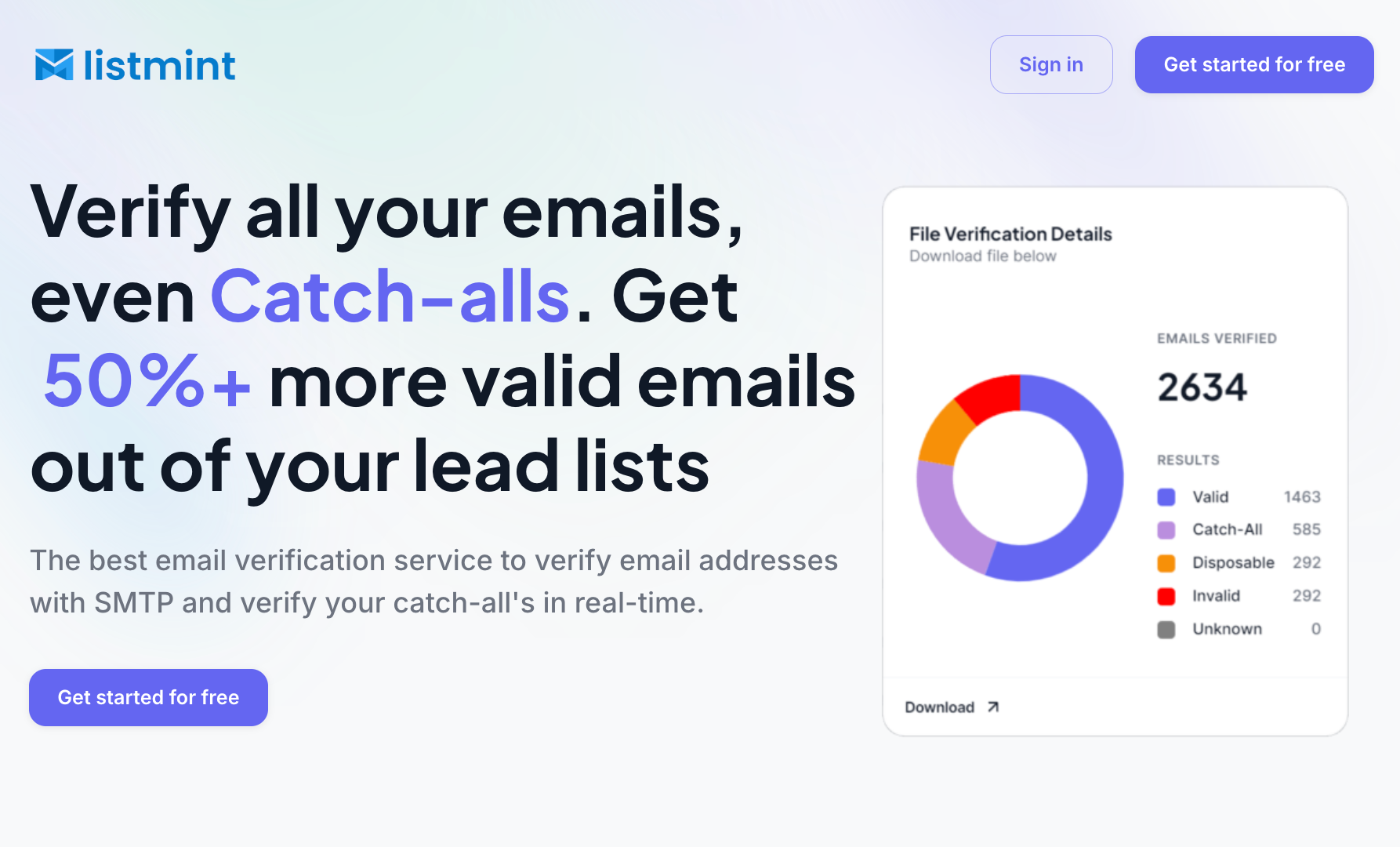
Listmint is an email verification platform built for businesses that want more than standard SMTP verification.
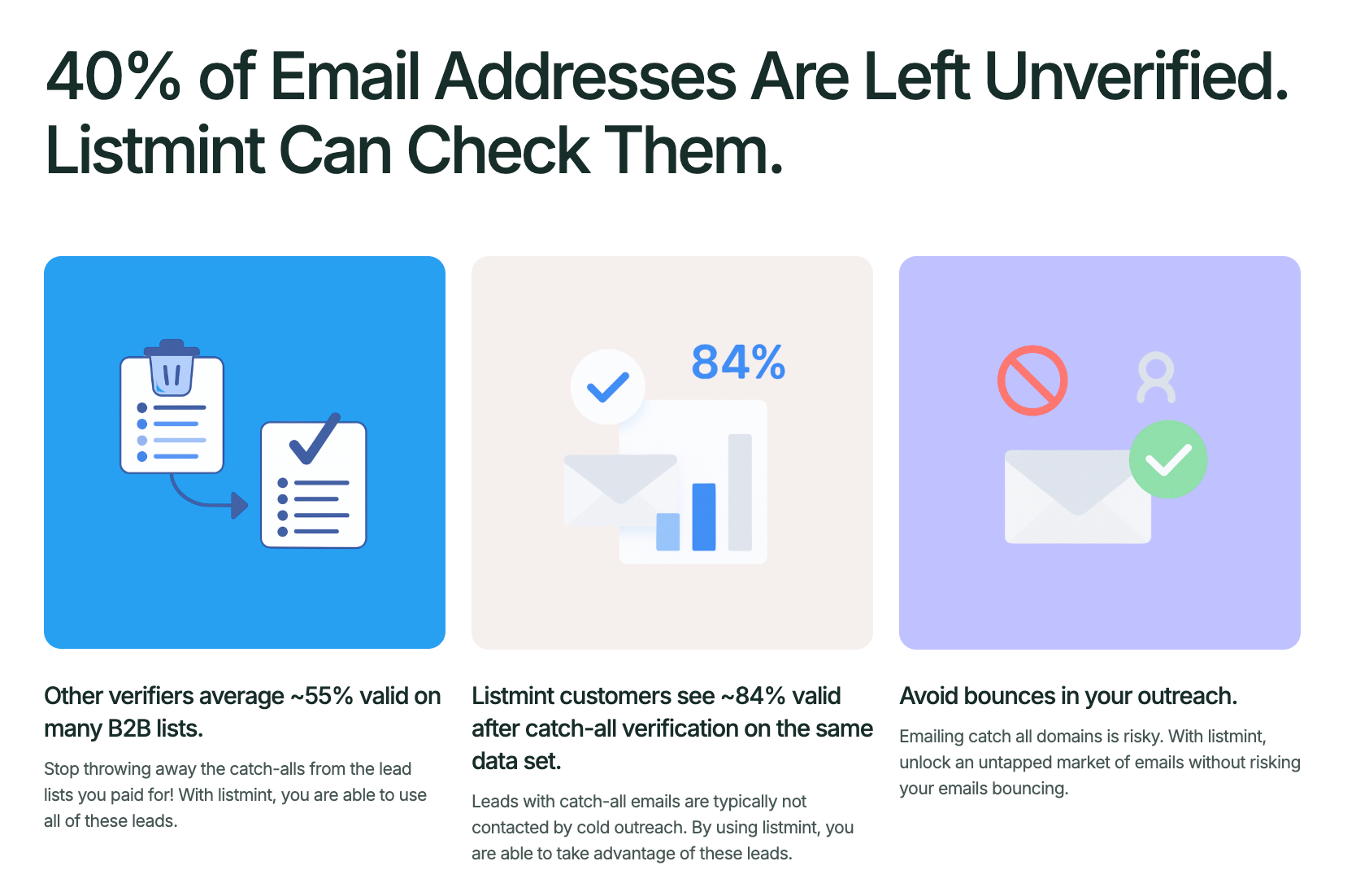
It combines real-time catch-all verification, disposable detection, and standard email verification to help businesses recover valuable contacts that many verification tools simply label as risky or unknown.
Instead of stopping at a generic catch-all result, Listmint verifies those addresses and classifies them as catch_all_valid or catch_all_invalid in real time.
That gives marketing and sales teams more confidence when working with catch-all domains, while reducing unnecessary list loss before outreach begins.
Listmint has verified more than 1 billion email addresses and reports 99%+ SMTP verification accuracy and 99%+ catch-all verification accuracy, giving teams accurate results they can rely on when preparing lists for outreach.
Listmint is best for businesses that rely on outbound prospecting, email marketing, or lead generation and need to verify both standard and catch-all email addresses in a single platform.
It is also a great fit for developers who need a verification API with real-time results for applications and automated workflows.
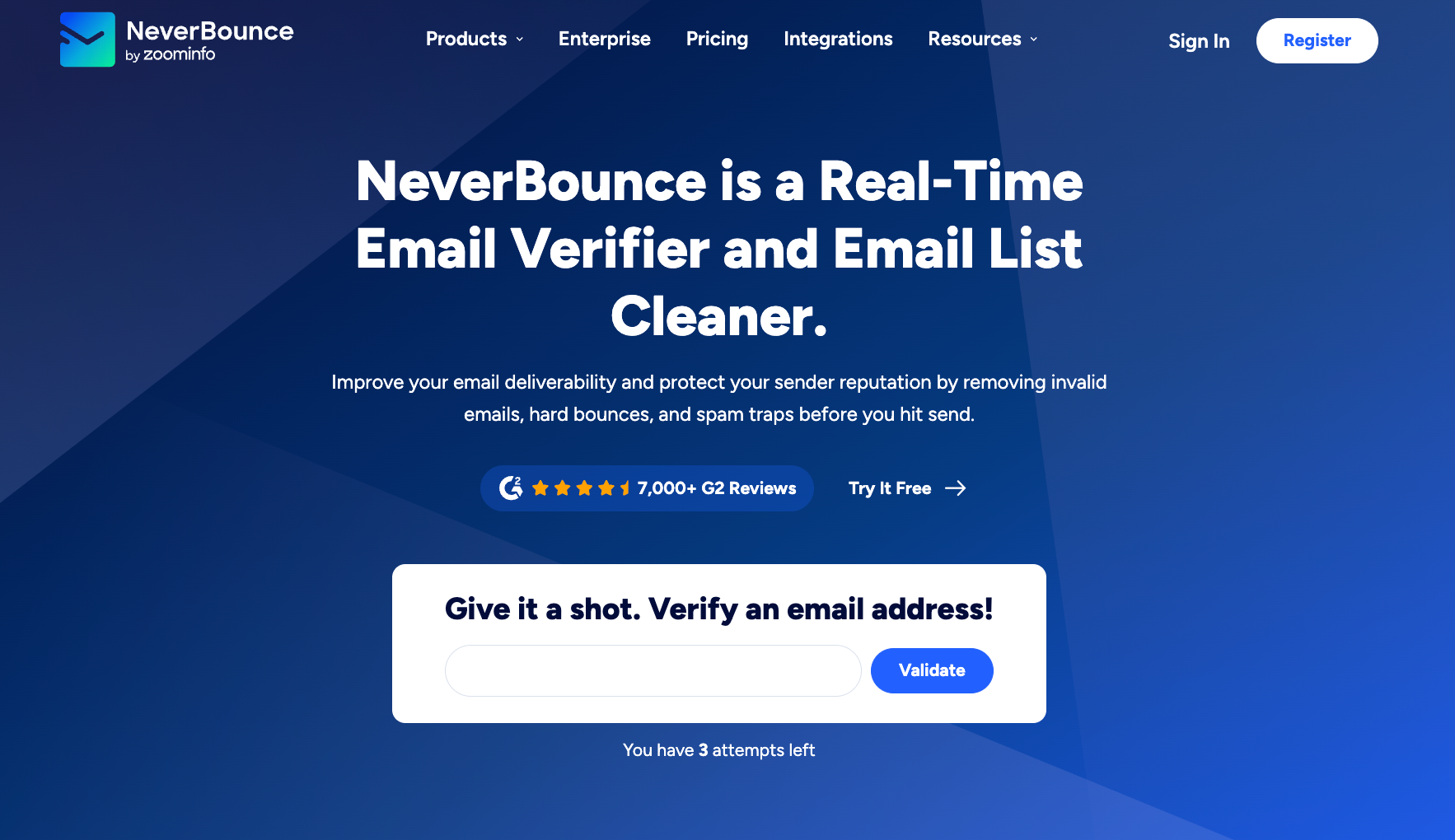
NeverBounce is an email verifier that allows businesses to clean an email list before sending campaigns.
It offers bulk list cleaning, real-time verification, automated list syncing, and an API, making it suitable for businesses that regularly verify large contact databases.
The platform also integrates with more than 85 applications, allowing teams to add verification to their existing workflows.
Recent pricing changes following its acquisition by ZoomInfo have led some reviewers to describe NeverBounce as more expensive than several competing email verification platforms.
A few users also mention slower customer support responses and concerns about credit expiration policies.
NeverBounce is commonly used by businesses that regularly clean large email lists and want automated verification through integrations or an API. Marketing teams also use it to reduce bounce rates before sending email campaigns.
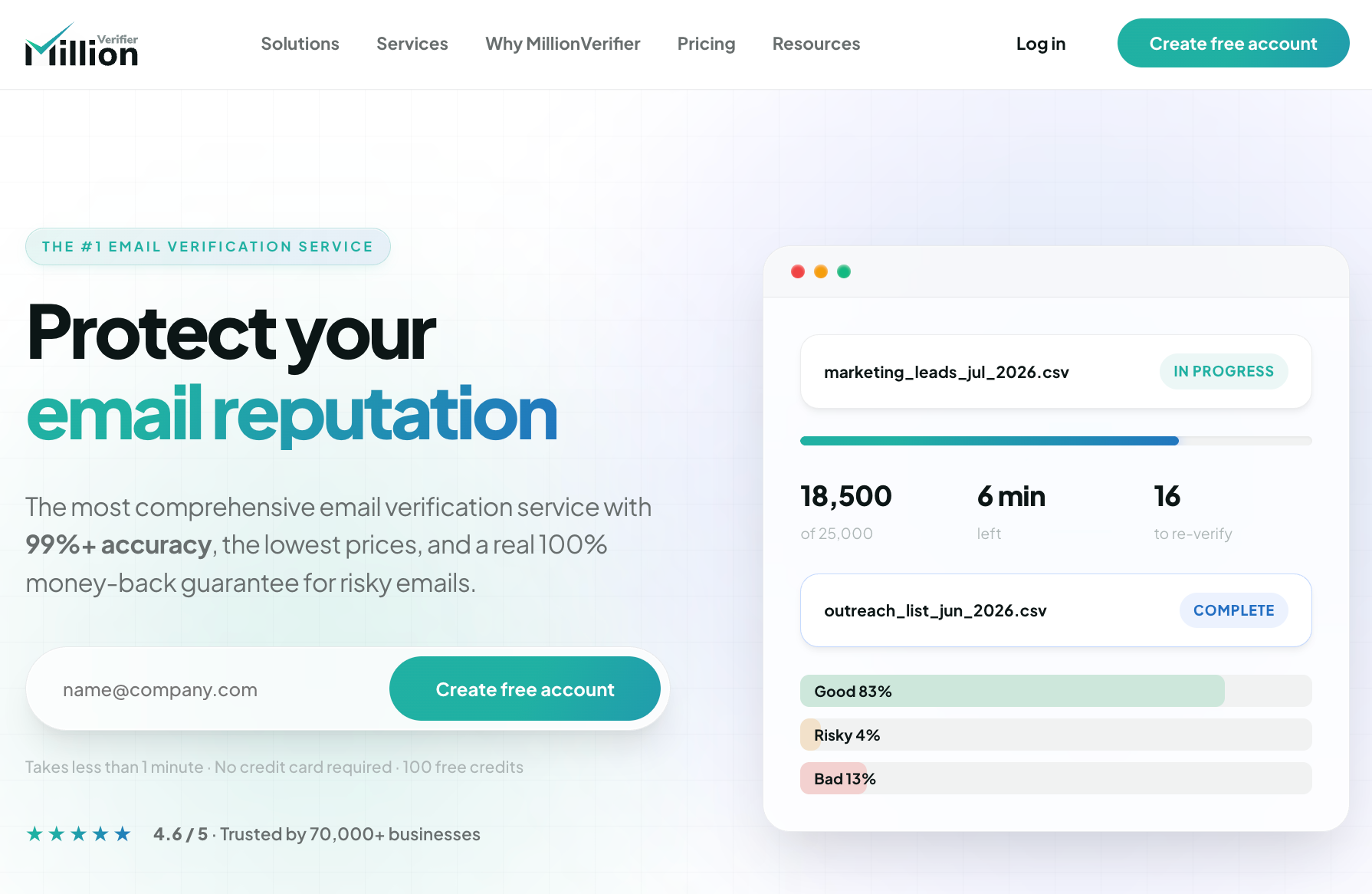
MillionVerifier is an email verification platform that offers single-email checks, bulk verification, automated list cleaning, and a verification API.
It includes integration support and uses a pay-as-you-go pricing model, allowing users to purchase verification credits that do not expire.
It is designed to handle both everyday email verification and large-scale verification projects.
Some users report slower verification speed when processing larger lists or occasional delays during uploads. Others mention credit system concerns, support response times, and finding the platform more expensive than some competing email verification services.
MillionVerifier is intended for businesses that regularly verify large email lists and want a credit-based model without a monthly subscription. It also suits teams that rely on bulk verification and API integrations.
Kickbox is an email verification platform that offers bulk email list cleaning, an email verification API, and deliverability consulting.
It helps businesses verify email addresses before they enter a database or are used in campaigns.
Developers can integrate the service using an API key to add real-time validation to web forms, mobile apps, and other applications.
The credit-based pricing model may not suit businesses that prefer a predictable monthly subscription. Reviews also mention occasional questions about data accuracy, handling of risky email addresses, and API documentation.
Kickbox is designed for developer-focused workflows in which email verification occurs automatically via an API. Marketing teams can also use it to clean email lists and validate addresses as new contacts are collected.
Verifalia is an email verification platform that provides email list cleaning, real-time verification, and a developer API.
It supports single-email checks, bulk verification, embeddable verification widgets, and integrations through services such as Zapier and Pipedream.
It also offers advanced account management features for organizations that need shared access and administrative controls.
Verification of very large email lists may take longer than expected, according to some user feedback. The platform also offers a wide range of configuration options, which may require additional setup for businesses looking for a simpler verification workflow.
Verifalia is suited to teams that need advanced verification controls, developer tools, and integration options. It also meets the needs of organizations managing multiple users or client access through shared accounts and enterprise-level administration.
BriteVerify, now part of the Validity platform, focuses on verifying contact data before it enters a CRM or marketing database.
In addition to email validation, it supports phone and address validation, duplicate management, and data quality monitoring, making it part of a broader contact data quality solution.
Organizations that only need standalone email verification may find the broader platform includes more features than they require. Some users also report concerns about pricing transparency, credit usage, and understanding certain verification results.
BriteVerify is designed for organizations that want to combine email verification with broader contact data quality management. It can also suit small teams looking to improve CRM data alongside email verification.
There isn't a single best Clearout alternative for every business. The right choice depends on how you verify email addresses, the size of your contact lists, the tools you use, and the workflow you want to support.
If your priority is recovering more usable leads, verifying catch-all email addresses in real time, and preparing cleaner lists for outreach or marketing campaigns, Listmint is well worth considering.
It verifies both standard and catch-all email addresses on a single platform, helping you recover more valid contacts while reducing the risk of unnecessary bounces.
Yes. Clearout remains a capable email verification tool for teams that need email verification, bulk list cleaning, an email finder, and API access. The right choice depends on your workflow, budget, integration requirements, and the type of email verification your business needs.
It can, but not by itself. Better deliverability depends on maintaining a clean email list, verifying addresses, and following good sending practices. Choosing a provider that fits your workflow can support those efforts.
You can, but re-verifying your existing email list is generally recommended. Email data changes over time as inboxes become inactive, domains change, or contacts leave a company. Running a fresh verification helps improve the accuracy of your list before your next campaign.
A good practice is to verify your list before every major campaign or whenever you add a large number of new contacts. Outbound teams that regularly build prospecting lists often verify new contacts before each outreach campaign to help reduce bounce rates.
Bulk email verification checks large lists of email addresses before campaigns are sent. Real-time verification checks each address as it is entered into a form or application, helping prevent invalid contacts from reaching your database. Some email verification providers also offer free credits so businesses can test the service before purchasing a plan.