BillionVerify covers several ways businesses verify email addresses, from real-time checks and bulk verification to API-based verification.
As an email verification tool, it checks syntax, domains, MX records, SMTP responses, and other signals that help determine if an address can receive email.
But the way you verify emails can change with your workflow. You may need more detail on catch-all addresses, different result types, easier bulk processing, specific integrations, or an API that fits how your systems already work.
That is where comparing other options becomes useful. This guide looks at the top six BillionVerify alternatives for email verification, what each one offers, and the differences worth considering for your business.
These are the top BillionVerify alternatives for email verification in 2026:
BillionVerify provides real-time verification, bulk verification, and an API for checking email addresses at different points in a workflow.

Its verification process starts with syntax validation, followed by domain and MX record checks to confirm that the domain has a route for receiving email.
It then uses SMTP verification to probe the receiving mail server without sending a message. BillionVerify also reports risk flags for disposable, role-based, free webmail, and catch-all addresses.
Its disposable email detection identifies temporary email services, while catch-all detection identifies domains configured to accept mail for any local part.
Results are returned as deliverable, undeliverable, risky, or unknown.
For catch-all domains, BillionVerify explains that the SMTP probe cannot isolate and confirm the individual mailbox because the server accepts every local part. In that case, BillionVerify returns an uncertain result instead of confirming the address.
Businesses can verify addresses individually, through uploaded lists, or through its API. BillionVerify also integrates with platforms such as HubSpot, Salesforce, Mailchimp, Klaviyo, Pipedrive, Zapier, and Make.
BillionVerify covers the main ways businesses verify email addresses, but verification providers can differ in how they handle specific workflows. Comparing multiple tools can make sense when your team needs a different approach to certain types of addresses or verification tasks.
You may look at alternatives if you:
Different email verification services can fit different business needs. The six BillionVerify alternatives below cover a range of options for verifying addresses, cleaning lists, and handling new contacts.
Listmint combines standard SMTP checks with dedicated catch-all verification, so businesses can handle both types of addresses in the same service.
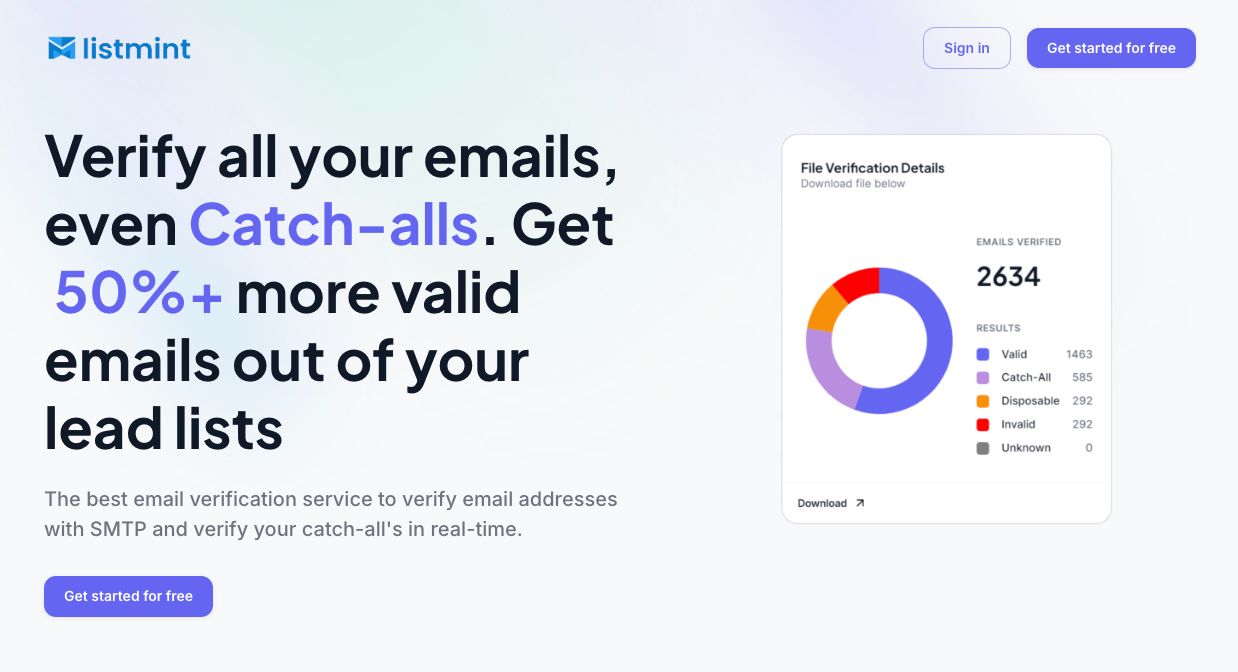
It supports real-time checks, bulk email verification, and a verification API for businesses that want verification built into their own products or lead workflows.
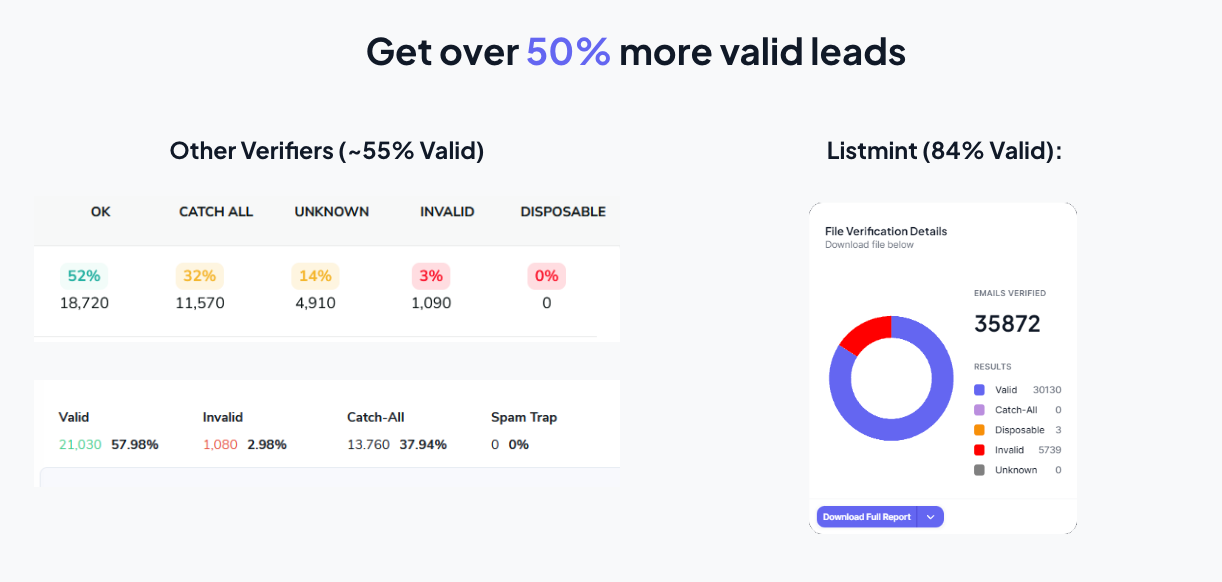
Listmint has processed more than 1 billion email verifications and maintains 99%+ accuracy for both SMTP and catch-all verification. Generic verifiers return about 55% valid results, while Listmint customers can see up to 84% valid results.
BillionVerify detects catch-all domains and explains that a normal SMTP probe cannot isolate the individual mailbox when the domain accepts every local part.
Listmint takes the process further with dedicated catch-all verification. Once those addresses go through the additional check, they can return as catch_all_valid or catch_all_invalid.
That distinction gives you a more direct next step. A catch_all_valid address can be treated as a valid contact, while a catch_all_invalid result can be removed. You do not have to leave every catch-all address grouped with other risky emails simply because the domain accepts all mail.
Listmint also runs catch-all verification without sending an email to the recipient. For businesses working with large B2B lead lists, that can help recover contacts that standard verification would leave unresolved.
Businesses, agencies, and API users that want reliable verification for standard addresses plus more actionable results for catch-all contacts.
See which emails are worth keeping. Sign up for free and verify your list with Listmint.
NeverBounce is an email verification service for checking individual addresses and cleaning existing email lists.
It offers real-time verification alongside bulk email list verification, with an API and integrations for connecting verification to existing workflows.
Similar to BillionVerify, NeverBounce can verify lists, check individual addresses, and run verification through an API.
NeverBounce puts particular emphasis on bulk list cleaning, with a workflow for uploading a list, identifying invalid addresses and other verification statuses, then downloading the cleaned data.
NeverBounce also offers Sync for automated list cleaning. This can be useful for teams that regularly need to remove bad addresses from lists stored in connected services without relying only on manual uploads.
Teams that regularly clean existing email databases and also need real-time verification for newly collected addresses.
Kickbox is an email verification service for checking existing lists and validating new addresses as they enter a database.
Its email validation results group addresses as deliverable, risky, or undeliverable, with added signals for disposable emails, role-based addresses, accept-all domains, and syntax errors.
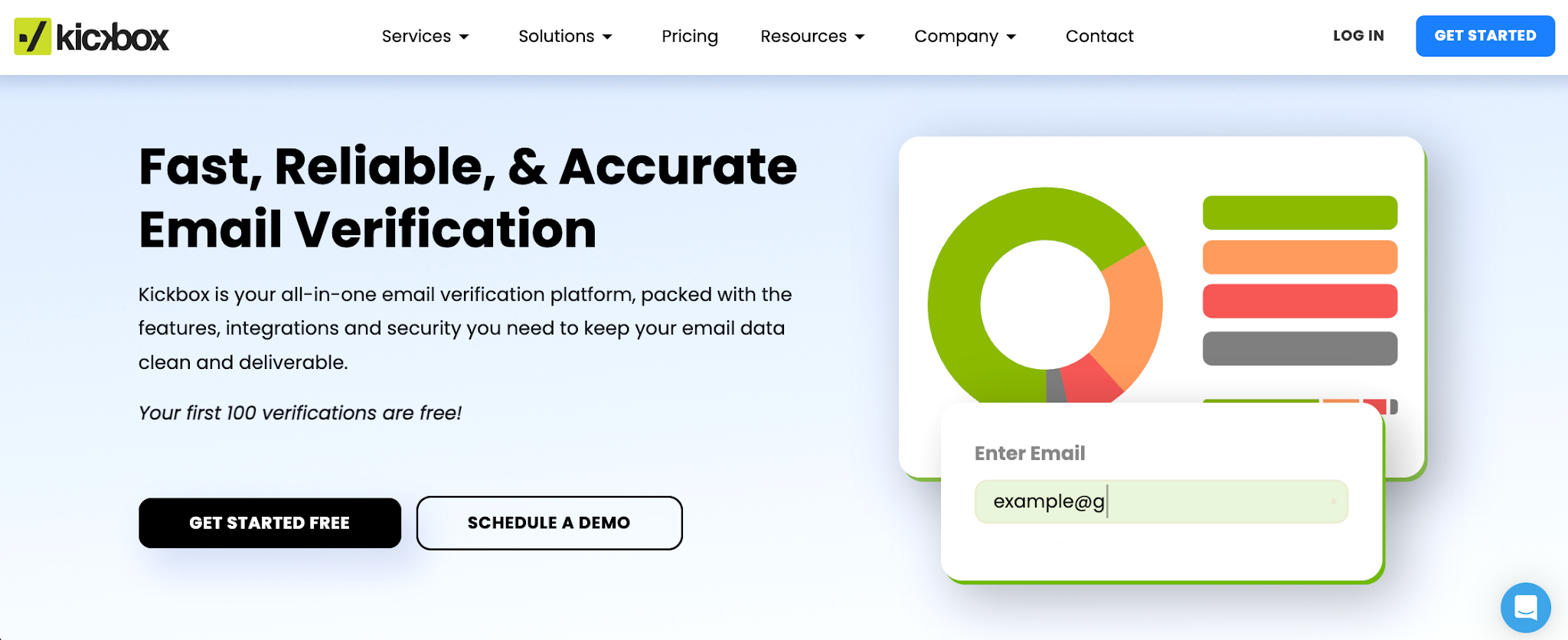
Like BillionVerify, Kickbox supports bulk list verification, real-time checks, and API-based verification.
Kickbox places strong emphasis on real-time validation at capture points such as web forms, signup pages, mobile apps, and other lead-capture systems.
That makes it useful for signup validation where teams want to catch typos, fake emails, or other invalid contacts before the address moves further into the database.
Teams that want to combine list cleanup with real-time checks at the point where new contacts are collected, helping protect sender reputation before email campaigns begin.
Clearout provides email verification for individual addresses, bulk lists, and real-time capture. It checks addresses for issues such as invalid mailboxes, disposable emails, spam traps, and catch-all domains.
Clearout also offers an email finder and data enrichment tools for businesses that need to work with contact data alongside verification.

Both Clearout and BillionVerify support bulk, real-time, and API-based email verification. Clearout differs in the additional tools available around that process.
Its email finding features let users search for professional email addresses using information such as a person's name, company, or domain.
For sales teams that need both verification and email discovery, this provides a way to find professional email addresses and verify them within the same service.
Sales teams that need email verification but also want access to email finding and related contact-data tools in the same service.
Verifalia is an email validation platform for checking individual addresses, cleaning uploaded lists, and verifying emails in real time.
Results are grouped as deliverable, undeliverable, risky, or unknown. Verifalia also provides more than 40 status codes that give additional detail about why an address received its classification.
Like BillionVerify, Verifalia supports bulk verification and API verification for individual addresses and lists.
Verifalia offers more configuration around API-based checks. Users also have control over how verification jobs run. They can choose the verification quality level and configure options for timeouts, deduplication, data retention, and callbacks.
These controls suit technical teams building custom list-processing pipelines or other automated verification workflows.
Technical teams that want detailed verification results or more control over how email verification is configured within API-driven workflows.
EmailListVerify is an email verification platform for checking uploaded lists and validating new addresses in real time.
Its verification process checks the basic setup of each address, including syntax, domain, MX records, and mailbox availability. It also looks for disposable emails, spam traps, duplicates, and catch-all domains.
Businesses can also verify email addresses one at a time or through an API.

Like BillionVerify, EmailListVerify supports bulk checks, real-time verification, and API-based workflows.
EmailListVerify keeps the process fairly simple for teams that mainly need basic list cleaning. Users can upload TXT, CSV, or XLSX files, review invalid or risky results, and download the cleaned data once processing is complete.
That makes it a practical option for businesses looking for straightforward verification without a more complex setup.
Businesses looking for a simple way to clean email lists and verify new addresses through an API.
Once you know why you are comparing providers, look at how each option fits the way your team actually verifies and manages email data. These are the main areas worth checking.
Look beyond a simple valid or invalid result. Labels for risky emails, unknown addresses, disposable inboxes, role accounts, and catch-all addresses can help you decide which contacts to keep, remove, or review.
You should also check what other email detection signals are available, such as spam trap detection, and how the platform handles invalid contacts. The best email verification tool for your team depends partly on what information you actually need to make sending decisions.
Catch-all addresses need a closer look because the domain may accept mail without confirming the individual mailbox. Check if a provider simply identifies the catch-all domain or provides more information about the individual address.
For B2B teams with a high number of accept-all domains, that difference can affect how many contacts are kept for further review.
If you regularly upload large lists, look at what happens from upload to export. Check supported file formats, deduplication, filtering options, processing limits, and how results can be downloaded or moved back into your workflow.
A simple verification workflow can save extra steps when bulk email checks are routine, especially for teams that rely on bulk processing before campaigns.
For new email leads and subscribers, check how the platform handles verification as an address enters your system. Real-time checks can be useful on signup forms, lead forms, and other capture points where you want to identify questionable data before it reaches the next system.
If verification is built into your own product or workflow, also compare the provider’s real-time API verification options.
Start with the systems your team already uses. Check if the verifier connects with your CRM, email platform, and other marketing tools, or if an API is available for a custom setup.
The number of integrations is less important than having the connections your workflow needs. Look at what data can move between systems and how verification results are stored or returned.
Estimate how many addresses you expect to check each month before comparing costs. Providers may use pay-as-you-go plans, subscriptions, or credit-based pricing, and the way credits are charged can differ by verification type or result.
An affordable email verification service at a smaller volume may not remain the lowest-cost option at a higher volume, so compare pricing using a volume that reflects your actual usage.
Choosing a BillionVerify alternative comes down to the type of verification your business needs. Bulk cleaning can help with existing databases, while real-time checks and API access can help verify new contacts as they enter your systems.
Catch-all verification is another area to consider. Listmint goes beyond identifying the domain by giving you more information about which catch-all contacts can be kept and which should be removed.
Verify your catch-all emails with Listmint. Get started for free.
The best free email verifier depends on how many addresses you need to check and what results you need. Several services offer free verification credits or limited free checks, so compare the allowance, catch-all handling, bulk verification, and API access before choosing one. Listmint is one option if you want to test both standard and catch-all email verification.
The right mail tester depends on what you want to check. For email verification, Listmint can check if an address is valid and run dedicated verification for catch-all emails. If you want to test where a sent email lands, such as the inbox or spam folder, you will need an inbox placement testing tool instead.
The cheapest email verification service depends on your verification volume and pricing model. Compare the cost for the number of emails you actually verify, since providers may charge through pay-as-you-go credits, monthly plans, or separate allowances for certain verification types.
There is no single email finder that is always the most accurate. Accuracy depends on the available data, the company or domain being searched, and how the service finds and verifies addresses. When comparing tools, look at how recently the data is checked and whether found emails are verified before you use them.
Often, yes, if the new service supports the tools you already use. Check for CRM and automation integrations, a Google Sheets add-on, or API access for custom setups and AI agent workflows. Keeping email verification connected to your existing systems can limit workflow changes when switching providers.