Outbound usually starts simple. Your team pulls a list, finds contact data, and launches campaigns with a few clicks. Then the volume increases. Credits disappear faster, email accuracy becomes inconsistent, and reps spend more time checking records before outreach.
That is where Hunter.io vs Apollo.io becomes a real comparison for sales teams.
Hunter.io and Apollo.io take different approaches to prospecting. Hunter works better as a focused email finder with domain search and verification features. Apollo covers a broader outbound workflow with sequencing, automation, and prospecting in one system.
Both help teams find professional email addresses and build prospect lists, but they solve different problems once outreach starts scaling.
In this guide, we’ll compare Hunter and Apollo based on accuracy, prospecting, outreach, pricing, and workflow fit so you can decide which option makes more sense for your team.
Hunter and Apollo both help outbound teams find prospects and run outreach, but they approach the workflow differently.
One focuses on fast email discovery and verification, while the other combines prospecting, sequencing, and sales workflows in a larger outbound system.
Hunter is a focused email finder built around domain search, publicly indexed web data, and email verification. You enter a company domain, and Hunter pulls available contact details connected to that business, including names, job titles, and professional email addresses.
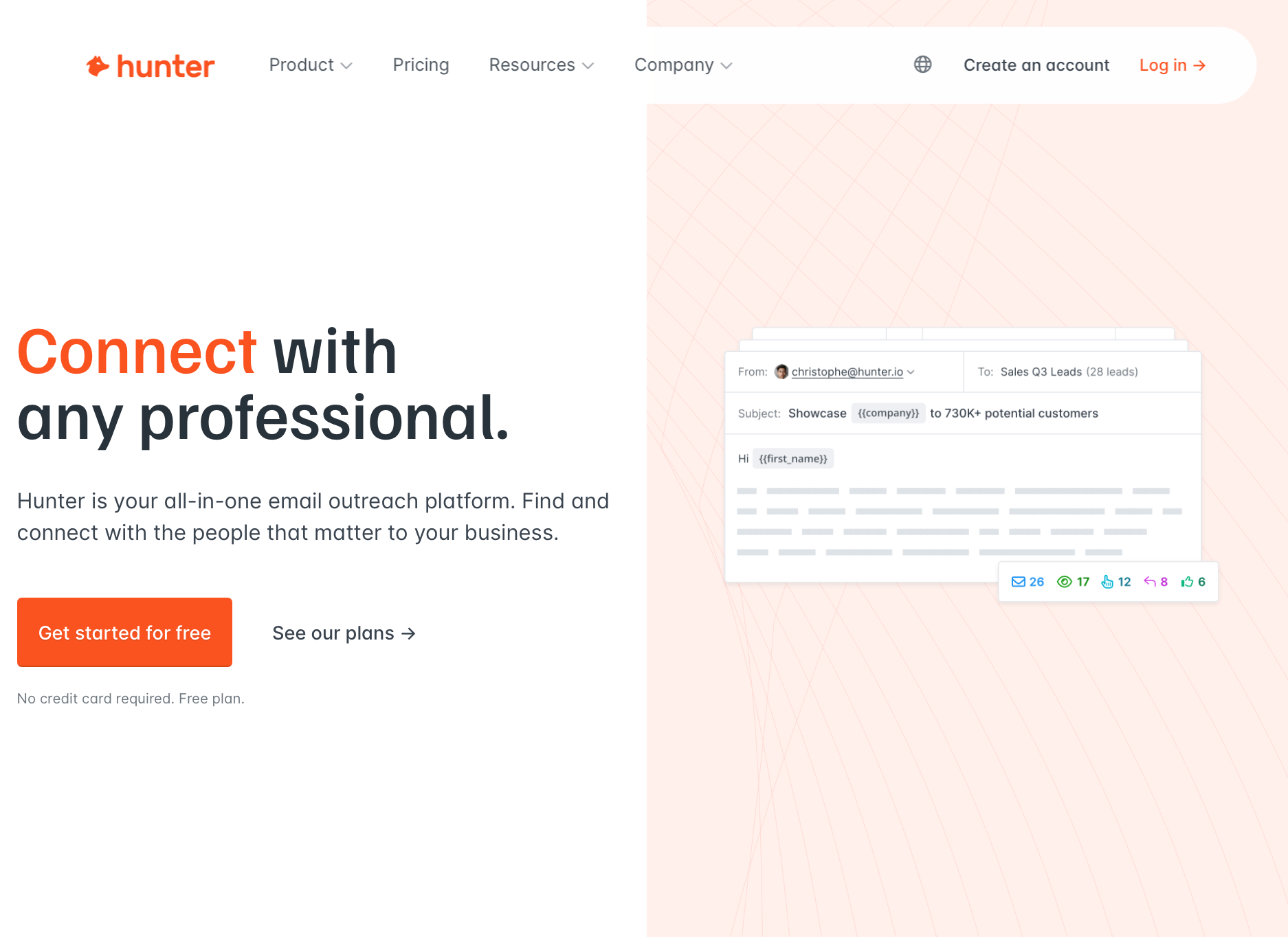
The workflow stays simple. Your team can use the email finder to look up a specific person or search an entire company website to find the right contact faster.
Hunter also verifies emails before outreach, which helps reduce bounced emails and protects the sender reputation during cold outreach. Confidence scores give reps a clearer idea of which contacts are safer to use before campaigns go live.
That focused setup works well for lean outbound workflows where the main priority is finding and verifying emails quickly without managing a larger sales system.
Apollo works more like an enriched B2B prospecting database combined with outreach and sales workflows. It combines contact discovery, sequencing, CRM features, and workflow automation inside a single outbound platform.
Your team can search a large contact database, filter prospects using company data and intent signals, then launch outreach campaigns without moving data between multiple tools.
Apollo also supports multichannel outreach with email sequences, phone numbers, task management, and meeting scheduling features. That setup makes more sense for teams running larger outbound workflows that need prospecting and execution in one place.
The tradeoff is complexity. Apollo covers more parts of the sales process, so setup and day-to-day management usually require more structure than Hunter.
Hunter fits smaller outbound teams, founders, recruiters, PR professionals, and marketers who mainly need lead generation through email discovery and verification.
Apollo fits sales teams that want prospecting, sequencing, automation, and CRM-style workflows in one system. It works better once outbound campaigns involve larger prospect lists, higher outreach volume, and multiple reps working together.
Here’s a quick side-by-side look at how Hunter and Apollo compare on the features that usually affect buying decisions.
Use this table to scan the main differences before going deeper into accuracy, outreach, pricing, and workflow fit.
Good prospecting starts with quality data. Bad records waste credits, slow reps down, and create problems later once outreach volume starts growing.
Hunter focuses heavily on email finding through domain patterns and publicly available web data. Reps can search a company, pull professional email addresses, and review confidence scores before outreach starts.
The platform also includes an email verifier that uses real-time SMTP verification to help with verifying email addresses before campaigns go live. That setup works well for teams that want straightforward prospecting and verification inside one workflow.
Apollo approaches prospecting differently. It combines enrichment data, outreach activity, and a large contact database to help teams surface verified contacts and build bigger lead lists faster. The tradeoff is that email accuracy can vary when records become outdated or inactive over time.
Even with SMTP checks, neither platform fully solves catch-all verification at scale. Catch-all domains can still return risky or unknown results instead of a confirmed valid or invalid status, which creates extra uncertainty before outreach starts.
Apollo clearly leads in database size. Its large contact database includes company data, phone numbers, buying signals, firmographic data, and detailed filters tied to millions of businesses.
The wider data scope inside Apollo helps reps build more segmented prospect lists. Teams can filter target companies using revenue size, hiring signals, technologies, departments, and job titles before outreach starts.
Hunter keeps prospecting simpler and more focused on direct email lookup. It performs best when reps already know which company or domain they want to search.
The tradeoff is straightforward. Apollo offers more scale and prospect depth. Hunter keeps prospecting simpler with less clutter but more limited data coverage outside email discovery.
Fresh records usually outperform massive databases filled with stale contacts. Reliable data becomes more important once reps start scaling outreach.
Hunter keeps its process centered around publicly indexed contact details and direct verification workflows. That helps improve contact reliability for email-first prospecting.
Apollo handles larger enrichment workflows tied to CRM data, prospecting lists, and sales activity. The upside is more extensive coverage. The downside is that older contact details can stay active longer before teams verify data again.
No database stays perfectly current. Employees switch jobs constantly, inboxes get disabled, and businesses restructure all the time. Accurate data today may already be outdated next quarter.
Small data problems grow fast once outbound volume increases. A few bad contacts can quickly turn into hundreds of bounced emails during larger sends.
That creates bigger issues beyond reporting. Poor records hurt sender reputation, trigger spam filters, and weaken overall email deliverability over time.
Hunter and Apollo both reduce obvious bad records, but neither fully removes risk from stale contacts, inactive inboxes, or catch-all domains.
Outbound teams usually notice these gaps once campaigns stop performing consistently or inbox placement starts dropping.
Hunter and Apollo approach prospecting very differently. Hunter focuses on direct email lookup, while Apollo focuses more on large-scale targeting and outbound prospecting workflows.
Hunter centers its workflow around domain search. Reps enter company websites or business domains, then pull available contact data tied to that company.
That setup works well when teams already know who they want to target. A quick email search can surface available contacts, company patterns, and verified addresses without extra filtering steps.
The workflow stays lightweight and easy to manage. Hunter works best for direct prospecting where speed is more important than advanced targeting systems.
Apollo focuses more heavily on filtering and segmentation. Teams can use intent data, hiring activity, technologies used, and firmographic data to narrow prospect lists before outreach starts.
The platform also supports filtering by department, company size, seniority, and job titles. That makes it easier to prioritize target companies with stronger buying signals.
Apollo fits SDR teams that manage larger prospect lists and shared outbound pipelines.
Neither platform handles every prospecting scenario perfectly.
Hunter can struggle with limited data for smaller companies, local businesses, or newer domains with minimal public visibility.
Apollo offers broader coverage, but data quality becomes harder to maintain at a massive scale. Some records still contain outdated information, weak intent signals, or incomplete profiles.
Accurate data still depends heavily on regular list cleanup and verification before campaigns launch.
Hunter works better for focused lead generation when reps already know which companies they want to contact.
Apollo works better for outbound campaigns that depend on segmentation, enrichment, and broader prospect discovery.
The better choice depends on how your team builds lists. Smaller workflows usually benefit from Hunter’s simplicity. Larger outbound motions usually benefit from Apollo’s broader verified contact data and filtering depth.
Prospecting only solves part of outbound sales. Outreach execution becomes just as important once reps start managing sequences, follow-ups, and campaign performance.
Hunter keeps outreach tools simple. Teams can launch cold email sequences, schedule follow-ups, and manage basic outreach efforts from connected inboxes.
That setup works well for smaller prospect lists and lightweight outbound campaigns where reps mainly need email outreach without a full sales system attached.
The workflow stays clean and easy to manage, though reporting and automation remain fairly basic.
Apollo puts much more focus on automation and outbound execution.
Teams can build multi-step email sequences, automate follow-ups through workflow automation, assign activities through task management, and coordinate outreach with built-in meeting scheduling features.
That setup helps larger teams run multi-channel outreach using calls, emails, tasks, and prospect tracking from one system.
Hunter focuses mostly on straightforward email personalization and list management. The simpler setup reduces friction for smaller outbound workflows.
Apollo offers more flexibility for teams that want to connect tools together inside one outbound workflow. Reps can combine enrichment, prospecting, automation, reporting, and other marketing tools without constantly exporting data between systems.
That flexibility becomes more useful once outbound processes involve multiple reps and shared campaigns.
Deliverability problems usually appear once cold email campaigns scale.
Hunter helps reduce some risk through built-in verification and simpler sending controls. Apollo supports higher automation volume, but aggressive sequencing and poor list quality can still hurt sender reputation.
Bad records, stale lists, and inconsistent sending behavior can trigger spam filters on both platforms.
Neither system fully solves email deliverability on its own. Clean data and ongoing verification still play a huge role in long-term outbound performance.
Ease of use usually shifts once outbound workflows become more active. Shared prospect lists, larger campaigns, and growing rep activity can make Hunter and Apollo feel very different during everyday use.
Hunter has a simpler setup process. You can create an account, install the Chrome extension, run a search, and start finding emails in just a few clicks.
The interface stays focused on email lookup, verification, and lightweight outreach. Smaller teams usually get comfortable with it quickly because there are fewer settings and fewer moving parts.
Apollo takes more time to set up properly. Filters, sequencing rules, enrichment settings, and automation workflows need more configuration before campaigns are ready to launch.
Larger outbound teams may appreciate the added control, while leaner teams may find the onboarding process heavier than they need.
Hunter works better for beginners and lean outbound teams that mainly need email prospecting without managing a larger sales process.
Reps can search contacts, verify emails, and export lists without learning a full outbound system. Teams already using separate tools for CRM, sequencing, or reporting often prefer that lighter setup.
Apollo has a steeper learning curve because it combines prospecting, automation, outreach, and pipeline management inside one system. Teams using a basic CRM may appreciate the added structure, but newer users often need time to understand filters, workflows, and credit usage.
Advanced outbound teams usually benefit more from Apollo once multiple reps, campaigns, and channels are involved.
Hunter keeps list management straightforward. Teams can organize searches, verify emails, and move prospect lists into other systems quickly.
That setup works well when your team already has established processes for campaigns or CRM management.
Apollo centralizes more activity inside one workspace. Reps can manage prospect lists, outreach sequences, enrichment, and sales activity without constantly moving between separate tools.
That convenience becomes more useful once outreach volume grows and coordination between reps becomes harder to manage manually.
Hunter is easier to move through during direct prospecting work. Reps looking for company contacts or email addresses can usually find what they need quickly without extra setup.
Apollo manages more outbound activity inside the platform, including sequencing, enrichment, and reporting. The tradeoff is a more complex interface tied to the broader feature set available in each paid plan.
Teams focused on simple workflows often prefer Hunter. Teams trying to manage multiple tools from one outbound workspace usually lean toward Apollo.
Pricing looks simple at first, but total cost changes once credits, users, and outreach volume increase. Hunter and Apollo use very different pricing models, so the better value depends on how your team handles prospecting and outreach.
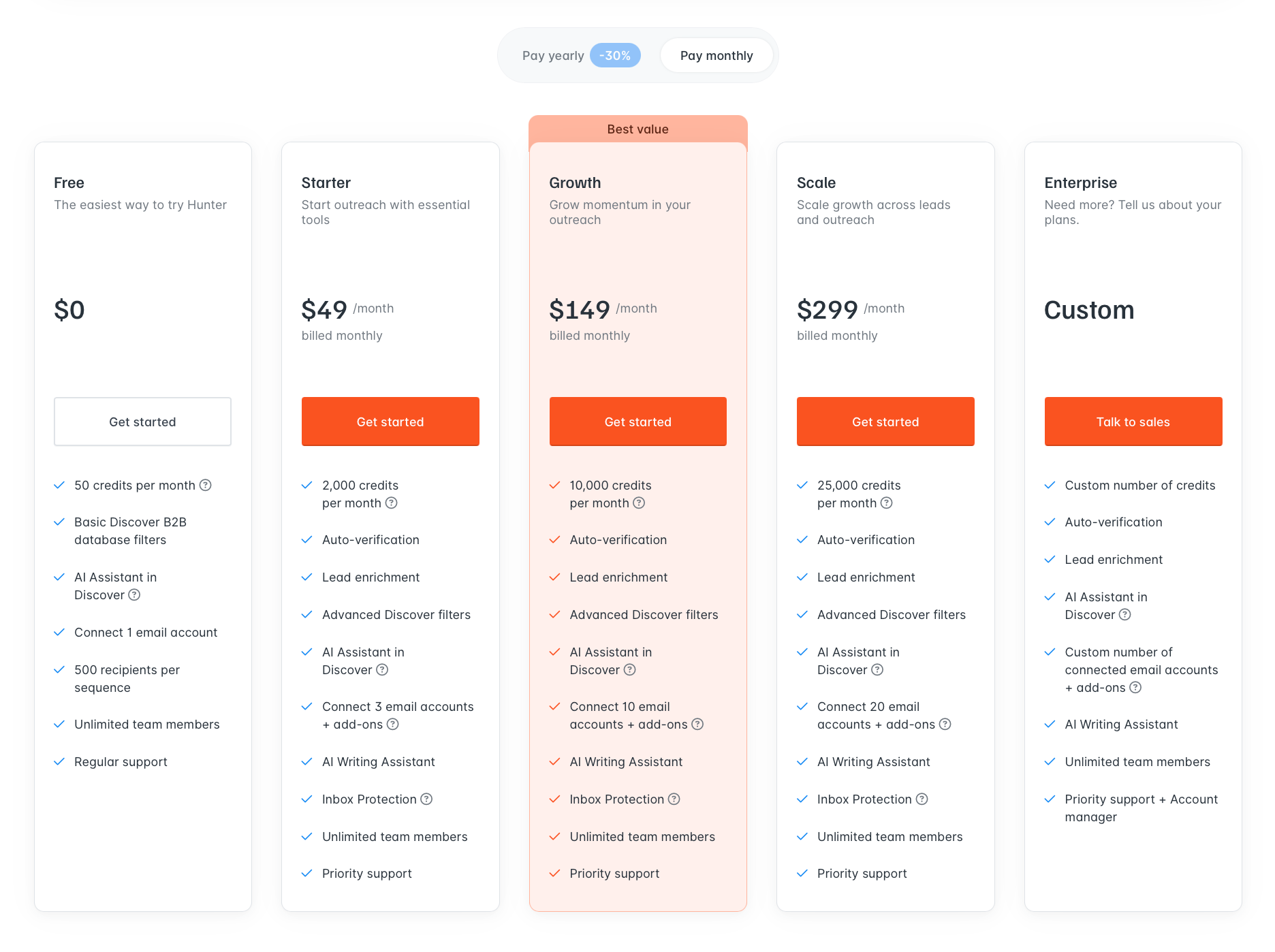
Hunter keeps pricing easier to predict for smaller outbound teams. The free plan gives enough credits to test prospecting workflows before upgrading.
Paid plans mainly scale through higher credit limits, connected email accounts, outreach capacity, enrichment features, and bulk verification workflows for larger lead lists. Unlimited users also help agencies avoid extra seat costs when adding more reps.
The simpler structure works well if your team mainly needs email prospecting and verification without paying for a larger outbound system.
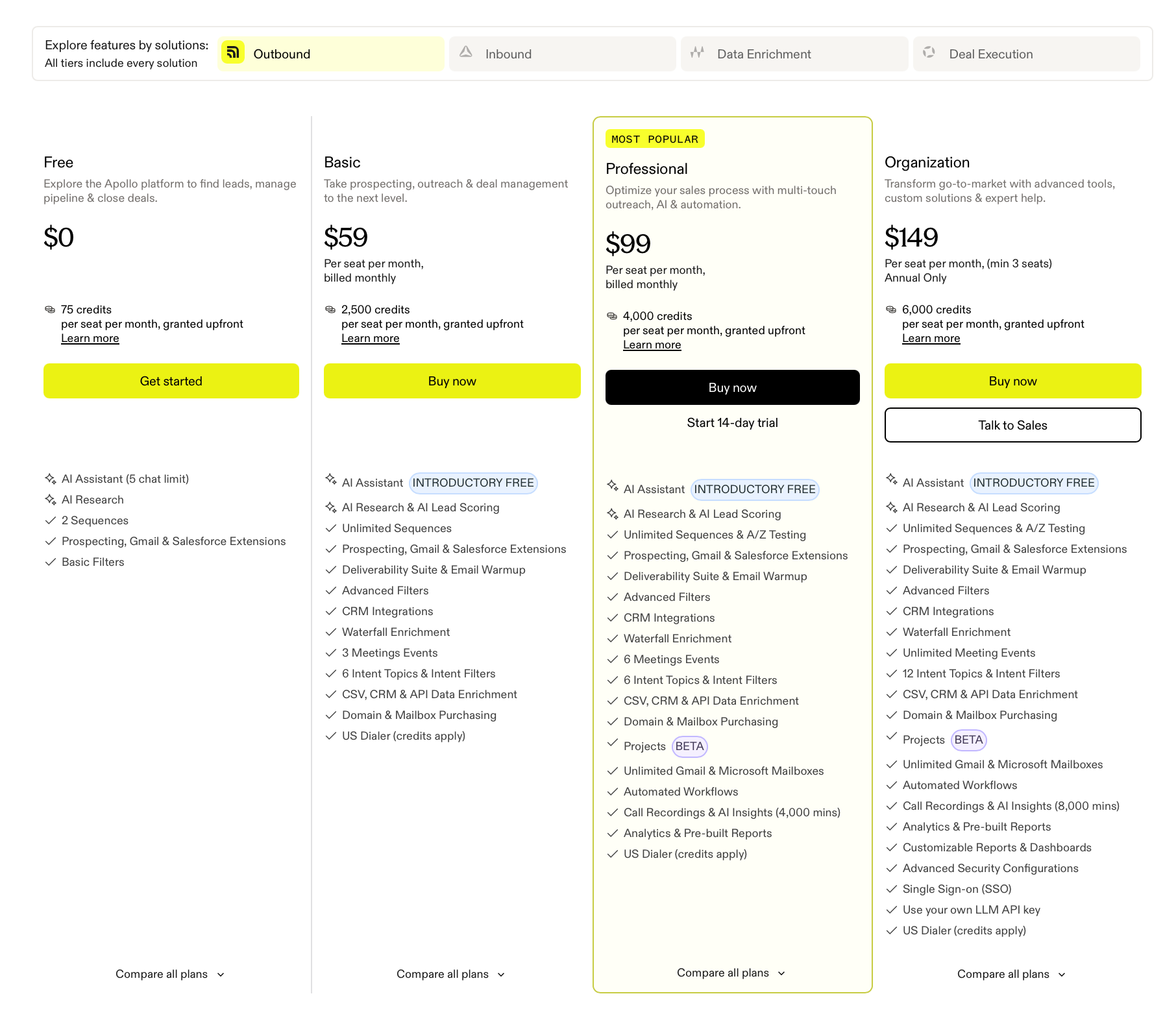
Apollo prices everything per user, which changes the total cost much faster as teams grow. Higher plans unlock larger credit pools, stronger data enrichment workflows, automation, and API access.
It also includes unlimited sequences on higher paid plans, but exports, enrichment, dialer usage, and certain prospecting actions still consume credits separately.
The broader feature set makes more sense for teams managing prospecting, CRM activity, and sequencing inside one system.
Hunter usually delivers better value for lean teams with moderate outbound volume. Smaller groups can manage prospecting and outreach without paying for features they may never use.
Apollo can justify the higher cost when larger teams need prospecting, automation, reporting, and CRM-style workflows in one place.
The bigger the sales operation becomes, the more Apollo’s bundled setup can replace separate outbound systems.
Scaling outbound can expose costs that are easy to overlook early on.
Hunter users often connect tools for CRM management, sequencing, or reporting outside the main system. Apollo reduces some of that complexity by keeping prospecting, sequencing, enrichment, and reporting inside one platform.
At the same time, Apollo credits can disappear quickly through exports, enrichment, dialer usage, and advanced workflows. Larger outbound teams should track credit usage closely before scaling aggressively.
Prospecting tools can help you find contacts faster, but they do not remove every risk before you send. The biggest gaps show up when lists include catch-all emails, stale records, and contacts that look valid but still fail during outreach.
Hunter and Apollo can help verify professional email addresses, but catch-all verification remains a problem.
Most tools detect catch-all domains and label them as risky, unknown, or unverifiable. That does not tell your team whether the inbox is real.
The result is simple. You either throw away possible leads or send them to risky contacts without enough confidence.
Verified contacts can still fail later. People leave companies, inboxes close, domains change, and old records stay inside lists longer than they should.
That creates bounced emails even when the contact looked safe at first.
Enough failed sends can hurt the sender reputation and make future outreach harder. It can also push more messages toward spam.
Small data problems get bigger as outbound volume grows.
A few bad records may not seem serious in a small test. In larger cold email campaigns, those same issues can turn into bounce spikes, weaker inbox placement, and lower reply rates.
Email deliverability depends on list quality, not just the tool you used to find the leads.
Prospecting tools are built to help you find contacts. They are not built to make every final send decision for every email on your list.
That gap becomes clear right before launch. Your team may already have a strong list from Hunter or Apollo, but some records still need deeper verification before they are safe to use.
That is where Listmint fits.
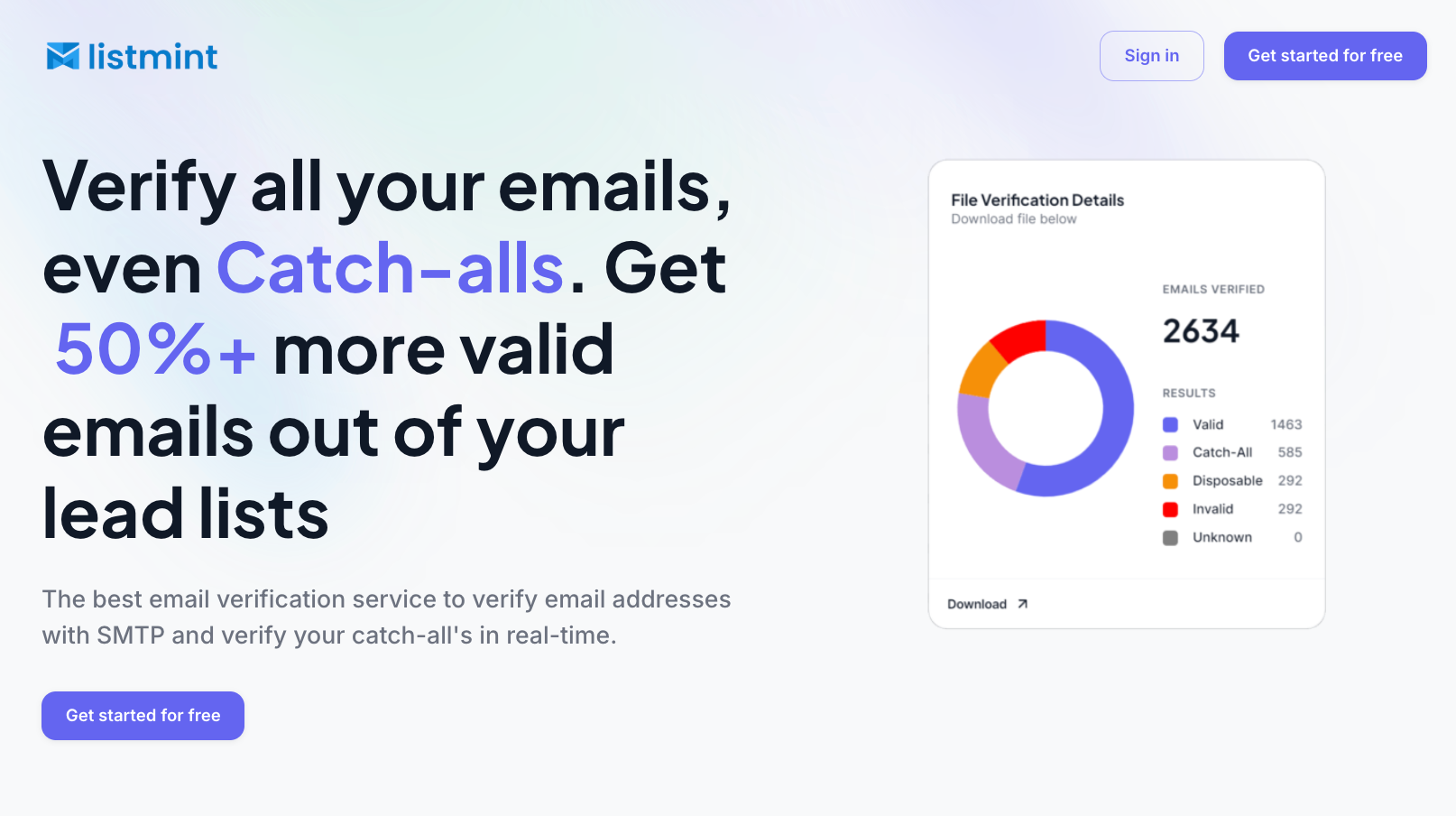
Listmint verifies standard and catch-all emails in one place. Instead of leaving catch-all records as risky or unknown, it checks them and separates them into usable results like catch_all_valid and catch_all_invalid.
That means your team does not have to treat verified catch-all emails as risky after Listmint checks them. If they are valid, reps can use them like other accurate email addresses before outreach starts.
Listmint also supports real-time SMTP and catch-all verification through its API. It does not need to send emails to verify addresses, and results do not take 48 hours.
That helps teams:
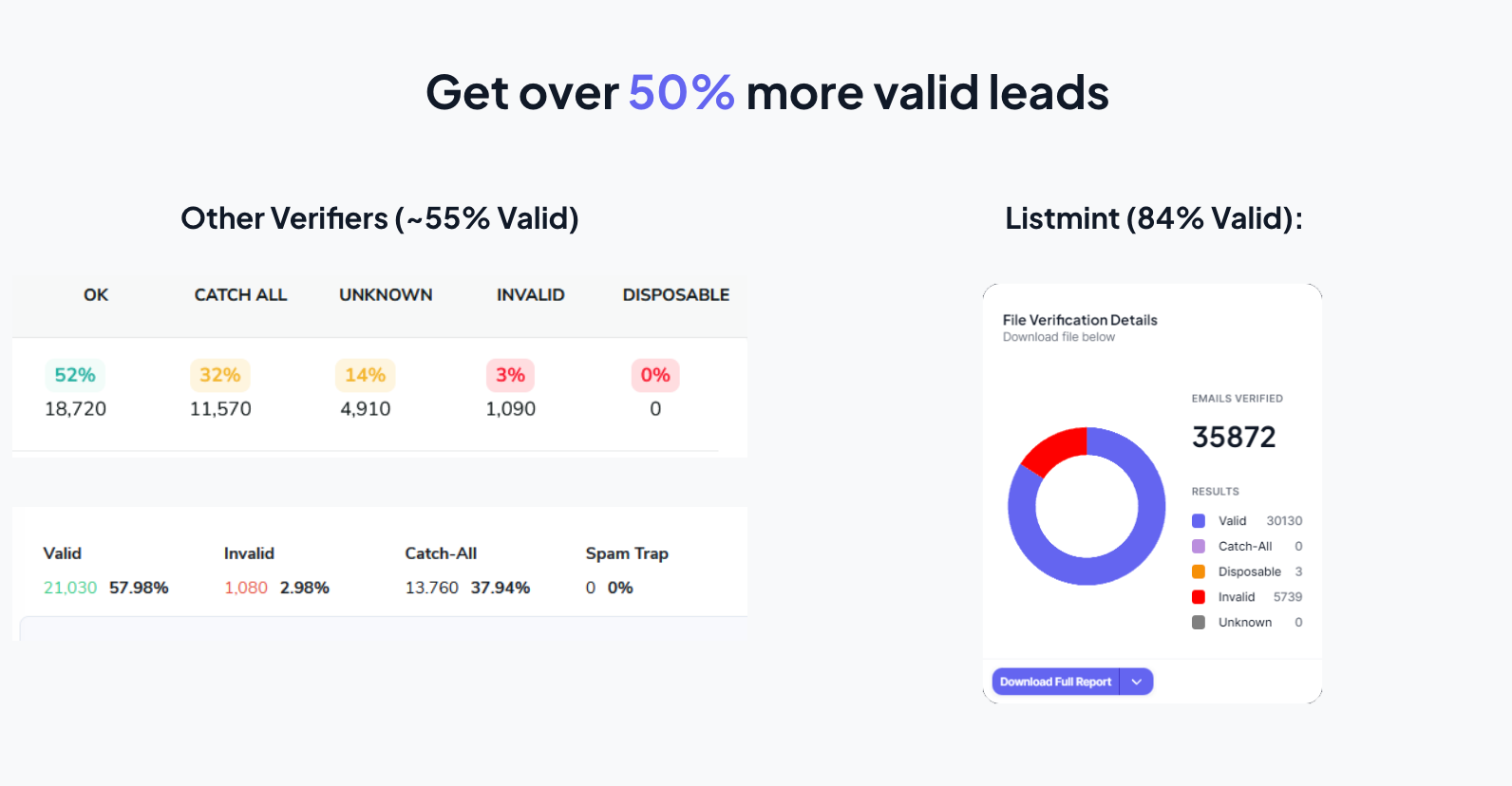
Listmint reports 99%+ SMTP verification accuracy, 99%+ catch-all verification accuracy, and over 1B emails verified. It also helps teams get 50%+ more valid emails from lead lists by verifying catch-all addresses instead of discarding them.
Hunter and Apollo solve different outbound problems. The better choice depends on how much of the workflow your team needs to manage inside one system.
Hunter works best when the main goal is to find and verify emails quickly.
It fits founders, recruiters, PR teams, marketers, and smaller outbound teams that already use other tools for CRM or sequencing. The workflow stays simple. Search a company, find contacts, verify emails, and export the list.
Teams that primarily focus on domain search and email lookup usually get value faster from Hunter because there is less setup and less platform management.
Apollo works better for teams looking for an all-in-one platform that combines prospecting, automation, sequencing, and CRM-style workflows.
It combines prospecting, sequencing, enrichment, automation, and pipeline management inside one system. Reps can build lists, launch campaigns, manage tasks, and track activity without constantly switching between tools.
That setup works well once outbound becomes more process-heavy and teams need shared workflows, reporting, and automation.
Neither Hunter nor Apollo fully solves verification at the final send stage.
That becomes more noticeable with larger lead lists, catch-all domains, and higher sending volume. Even verified contacts can still create bounce risk if the data is outdated or incomplete.
Listmint works as a verification layer after prospecting. It verifies standard and catch-all emails in real time, helps reduce risky sends, and helps teams clean lists before outreach starts.
That gives outbound teams a way to use more of the leads they already paid for while protecting sender reputation and improving deliverability.
Hunter and Apollo both have a place in outbound marketing.
Hunter is better when you need a focused way to find and verify emails. Apollo makes more sense when your team needs prospecting, sequencing, and outreach activity in one system.
The bigger issue starts after the list is built. Some contacts still need a final check before they are safe to use.
Listmint gives outbound teams a final layer of protection before sending.
It verifies standard and catch-all emails before outreach starts, so your team can reduce risky sends, protect sender reputation, and use more of the leads you already paid for.
Apollo is better for larger outbound teams that need prospecting, sequencing, automation, and CRM-style workflows in one system. Hunter is better for teams that mainly need a focused email finder, domain search, and lightweight verification without managing a larger outbound platform.
Apollo competes with several sales and prospecting platforms, including ZoomInfo, Cognism, LeadIQ, RocketReach, and Hunter. The best alternative usually depends on whether your team prioritizes database size, outbound automation, pricing, or email accuracy.
Yes. Apollo is still widely used by sales teams because it combines prospecting, outreach, CRM workflows, and automation in one platform. Its large contact database and outbound features help enable users to manage lead generation and outreach campaigns from a single system.
No. Apollo uses a credit-based system where email lookups, exports, enrichment, phone numbers, and other prospecting actions consume monthly credits. Higher plans include unlimited sequences, but teams can still hit credit limits as outbound volume grows. Many teams clean and verify Apollo exports with Listmint before sending to avoid wasting credits on bad or risky data.