
Businesses usually compare Listmint vs MillionVerifier for one of two reasons. They either need to clean a large email list before a campaign or verify new contacts as they enter a form, CRM, or sales workflow.
Both platforms support bulk and real-time email verification, but they emphasize different parts of the process.
MillionVerifier combines pay-as-you-go list cleaning with API access, integrations, and automated maintenance. Listmint places particular emphasis on real-time catch-all verification and clear catch-all results for ongoing verification workflows.
Those differences can influence how your team reviews risky email addresses, prepares outreach lists, and manages email data over time.
This comparison explains how both platforms differ, where each one fits best, and what to consider before choosing an email verification tool.
Listmint and MillionVerifier solve the same core problem, but they do not take the same approach. Before comparing them side by side, it helps to understand what each platform does and who it is built for.
Listmint is an email verifier that helps businesses check addresses before sales outreach, email marketing campaigns, or CRM updates.
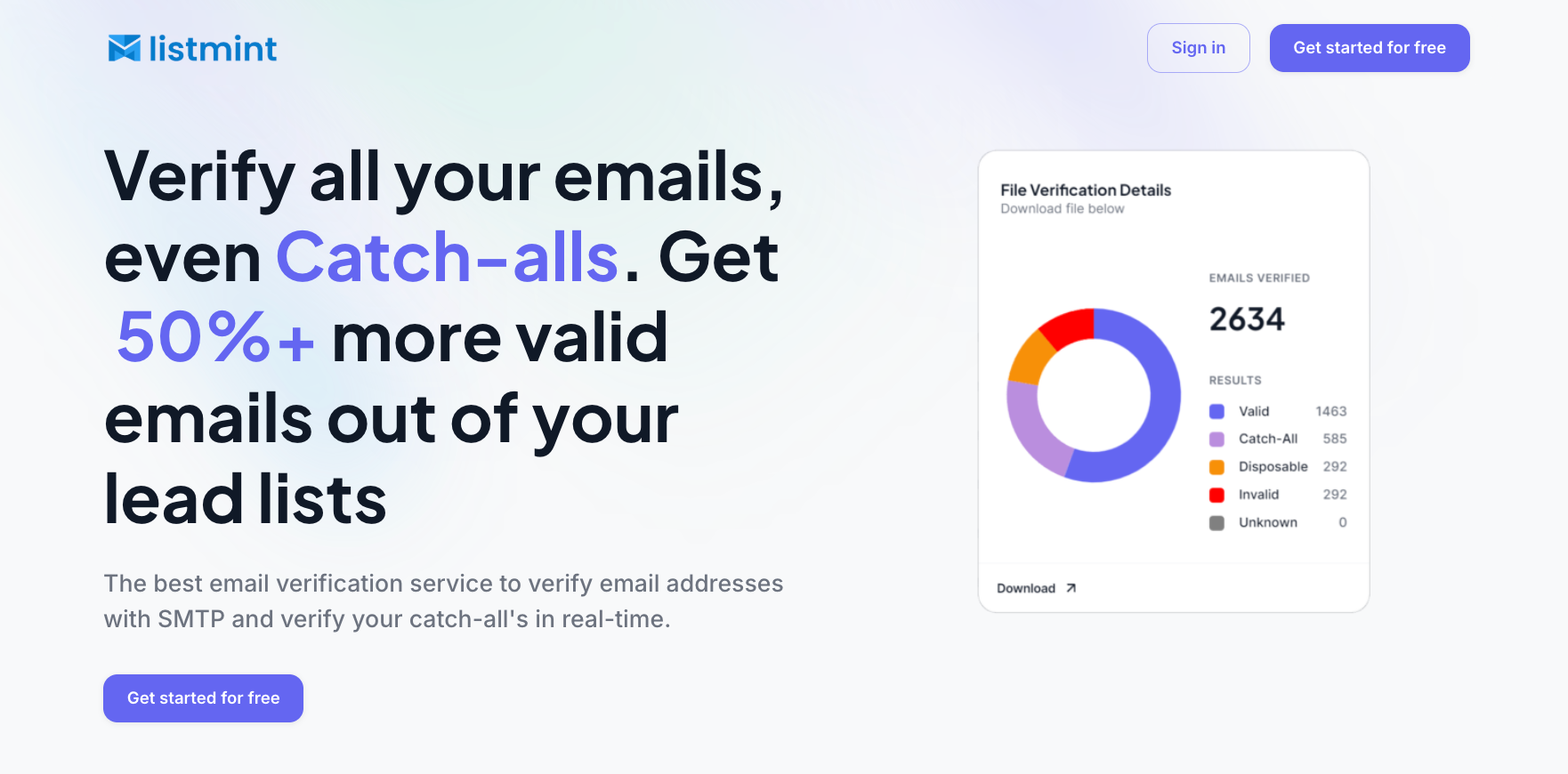
It is built for business owners, agencies, marketers, sales teams, and technical teams that want to reduce invalid contacts, lower bounce rates, and help protect domain reputation before sending.
The platform combines bulk SMTP verification with real-time catch-all verification. Users can upload lists through the web application to verify lists or use its email API to check contacts collected through forms, CRM systems, websites, and custom applications.
Listmint reports more than one billion emails verified and 99% verification accuracy for both SMTP and catch-alls. Its results include valid, invalid, catch_all_valid, and catch_all_invalid.
MillionVerifier is an email verification service that helps businesses check existing contact databases and new email addresses before using them for important campaigns, account registrations, or customer communication.
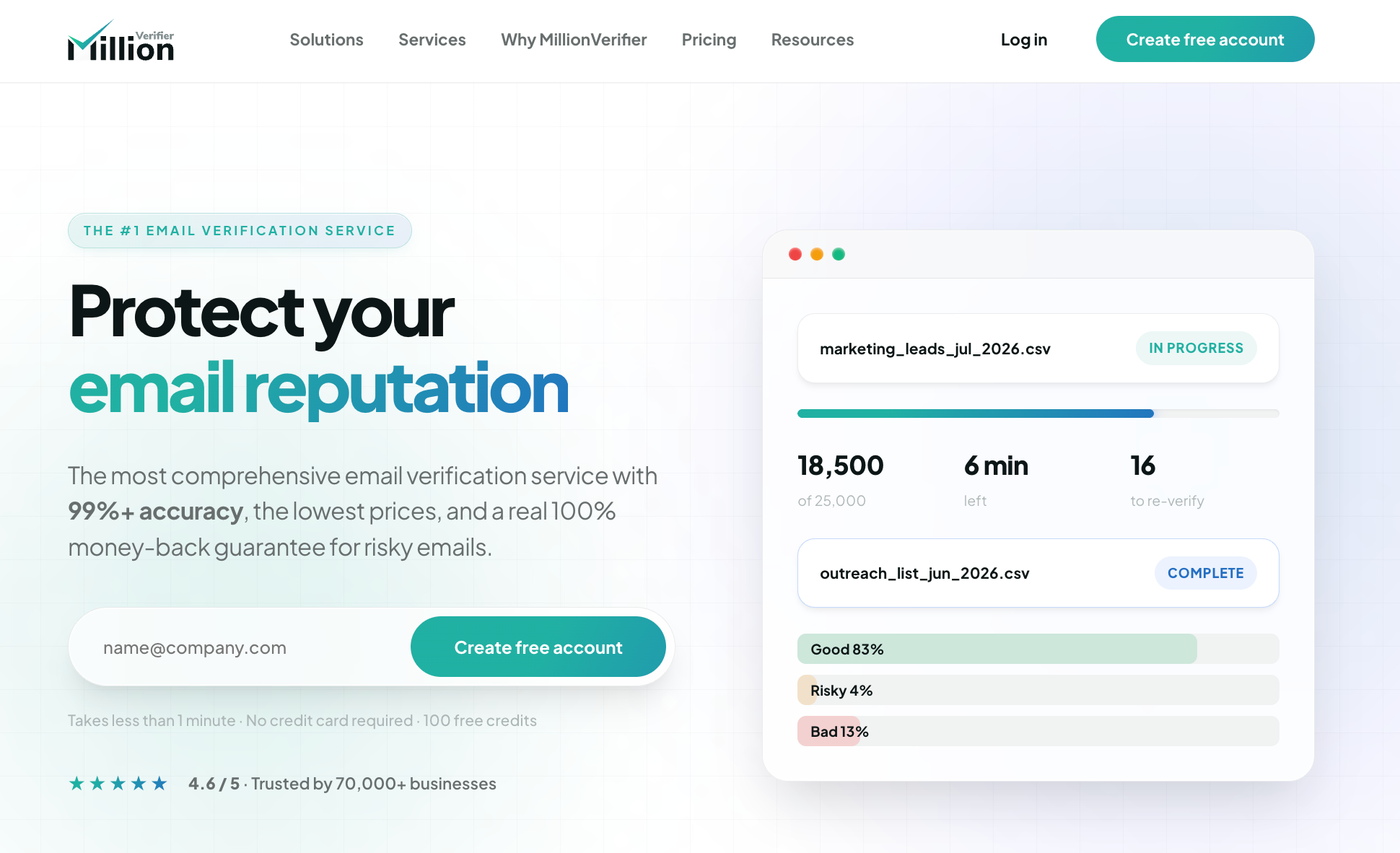
Its services include individual email checks, bulk list verification, real-time verification, catch-all verification, and automated list maintenance. The platform also provides API access, supports more than 40 native integrations, and offers GDPR compliance for businesses that handle customer contact data.
For bulk cleaning lists, users can upload TXT, CSV, or XLSX files, start the verification process, and download the completed results from the same page. The platform also offers an API for checking individual addresses in real time or submitting files programmatically.
MillionVerifier is used by email marketers, agencies, sales teams, developers, and businesses that maintain contact databases.
Teams can follow a simple verification workflow through manual uploads, connect supported marketing platforms or CRM systems, or use EverClean to verify connected lists on a recurring basis.
Both platforms verify email addresses and provide many of the same core capabilities. The table below highlights their main features and intended use cases before looking more closely at where their approaches differ.
Although both platforms support bulk and real-time verification, their main differences are clearer in catch-all handling, pricing structure, and ongoing list maintenance.
Listmint’s clearest distinction is how it handles catch-all addresses. It combines standard SMTP verification with real-time catch-all checks, reducing the need to manage multiple tools for those verification stages.
Removing invalid addresses is only one part of preparing an email list. Teams also need clear statuses that help them identify valid emails and decide which contacts to keep, remove, or review before sending campaigns.
Listmint returns classifications such as valid, invalid, catch_all_valid, and catch_all_invalid. These results give teams more direction when reviewing catch-all-heavy B2B lists and preparing valid leads for outreach.
Separating supported catch-all results into valid and invalid categories can reduce the number of uncertain addresses and help teams assess bounce risk more clearly.
Standard SMTP checks often cannot confirm whether a specific mailbox exists on a catch-all domain because the domain may accept messages for every address.
Listmint applies additional real-time checks and separates supported addresses into valid and invalid catch-all classifications.
These results are available through the platform and API response, giving sales teams, agencies, and marketers clearer information when reviewing B2B prospect lists.
Businesses that collect more contacts every day may need verification at the point of entry, not only before a major campaign. Listmint supports bulk uploads and API-based checks for forms, CRM systems, websites, and custom applications.
Developers can add real-time API responses to existing processes, while nontechnical teams can verify uploaded lists through the web application.
Because standard and catch-all verification are available through the same platform and API, teams can manage both checks within one workflow without always needing a separate second-pass tool.
This setup suits agencies, CRM managers, developers, and outbound teams that include verification in their email deliverability workflows.
MillionVerifier stands out for its flexible pricing model, native integrations, and recurring list maintenance through EverClean.
These strengths make it a practical choice for businesses that want multiple ways to verify contacts and keep email lists up to date over time.
MillionVerifier uses a pay-as-you-go pricing model, allowing businesses to purchase verification credits when needed.
Purchased credits do not expire, which can suit seasonal campaigns, irregular verification volumes, or occasional database cleaning. Teams do not need to commit to the same verification volume every month.
This structure may appeal to budget-conscious teams that want to control when they purchase credits or businesses whose verification needs change between campaigns.
Teams that already use supported CRM systems or marketing platforms can connect those tools directly to MillionVerifier.
Native integrations can reduce the need to export contact data, upload it manually, and import the completed results back into another platform. This may make the verification process easier for marketing and sales teams that prefer ready-made connections over building custom API workflows.
MillionVerifier also provides API access and includes catch-all verification as part of its verification process. Businesses that rely heavily on catch-all domains should compare how each platform classifies catch-all results and the level of detail provided.
EverClean supports businesses that want to review connected email lists on a recurring basis instead of relying only on one-time bulk cleaning.
The service checks connected databases regularly and helps identify addresses that may have become invalid over time. This can be useful for businesses that maintain large subscriber databases or collect new contacts continuously.
Teams can begin with manual bulk verification, then add EverClean when regular list maintenance becomes a larger part of their process.
Pricing is more than the cost per verification. Businesses should also compare how each platform structures credits, whether they expire, what features are included, and which pricing model best matches the way they verify email addresses.
Listmint uses a monthly subscription model with verification credits included in each plan. Businesses that verify contacts regularly may prefer a predictable monthly subscription instead of purchasing verification credits as needed.
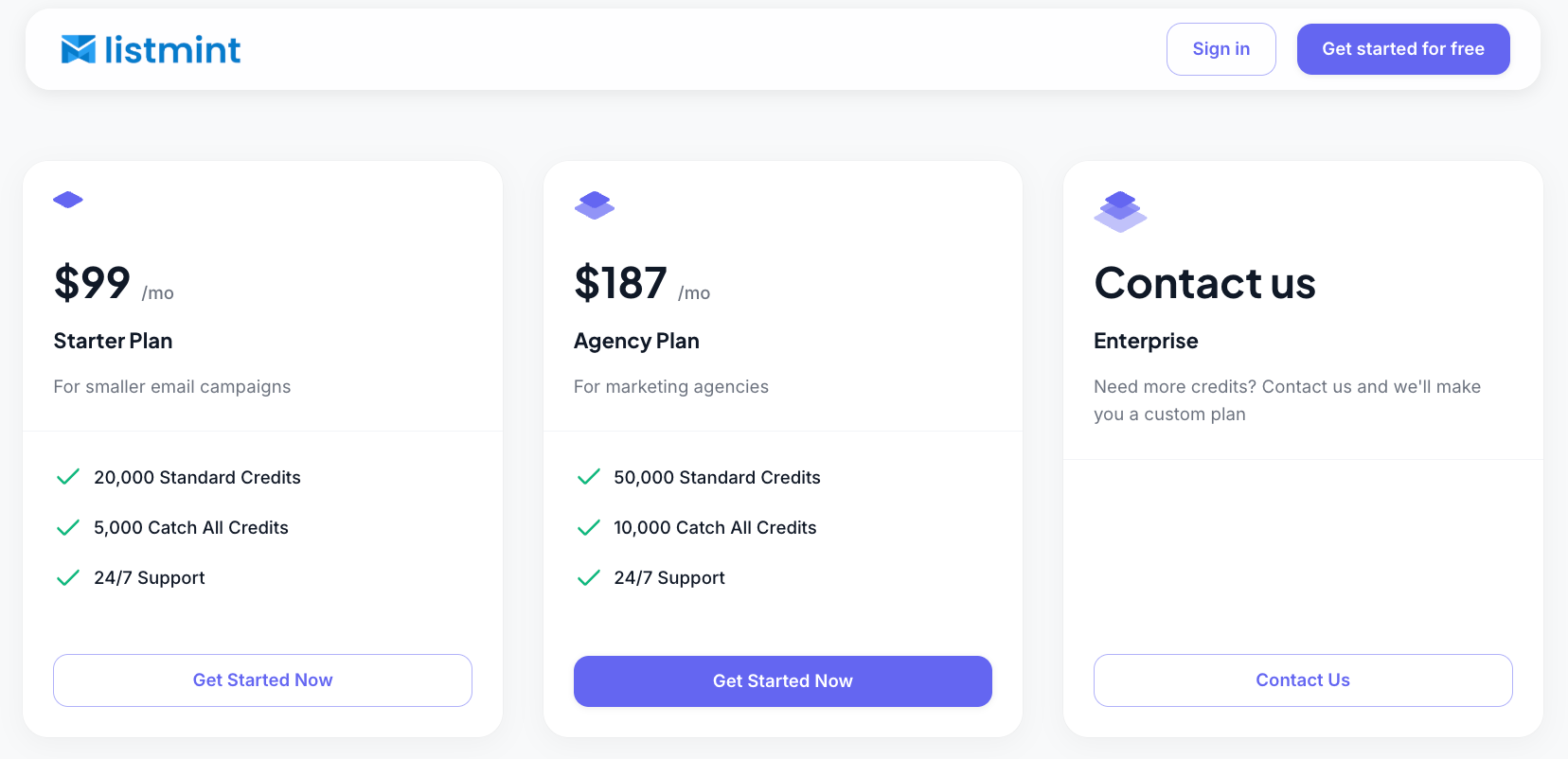
The Starter plan costs $99 per month, the Agency plan is $187 per month, and the Enterprise plan is available with custom pricing for higher volume verification needs.
Businesses should review each plan's included verification credits, API access, and expected monthly usage before choosing a subscription.
MillionVerifier uses a pay-as-you-go pricing model. Businesses purchase verification credits as needed, and unused credits do not expire. This pricing model can suit organizations with seasonal campaigns or verification needs that vary throughout the year.
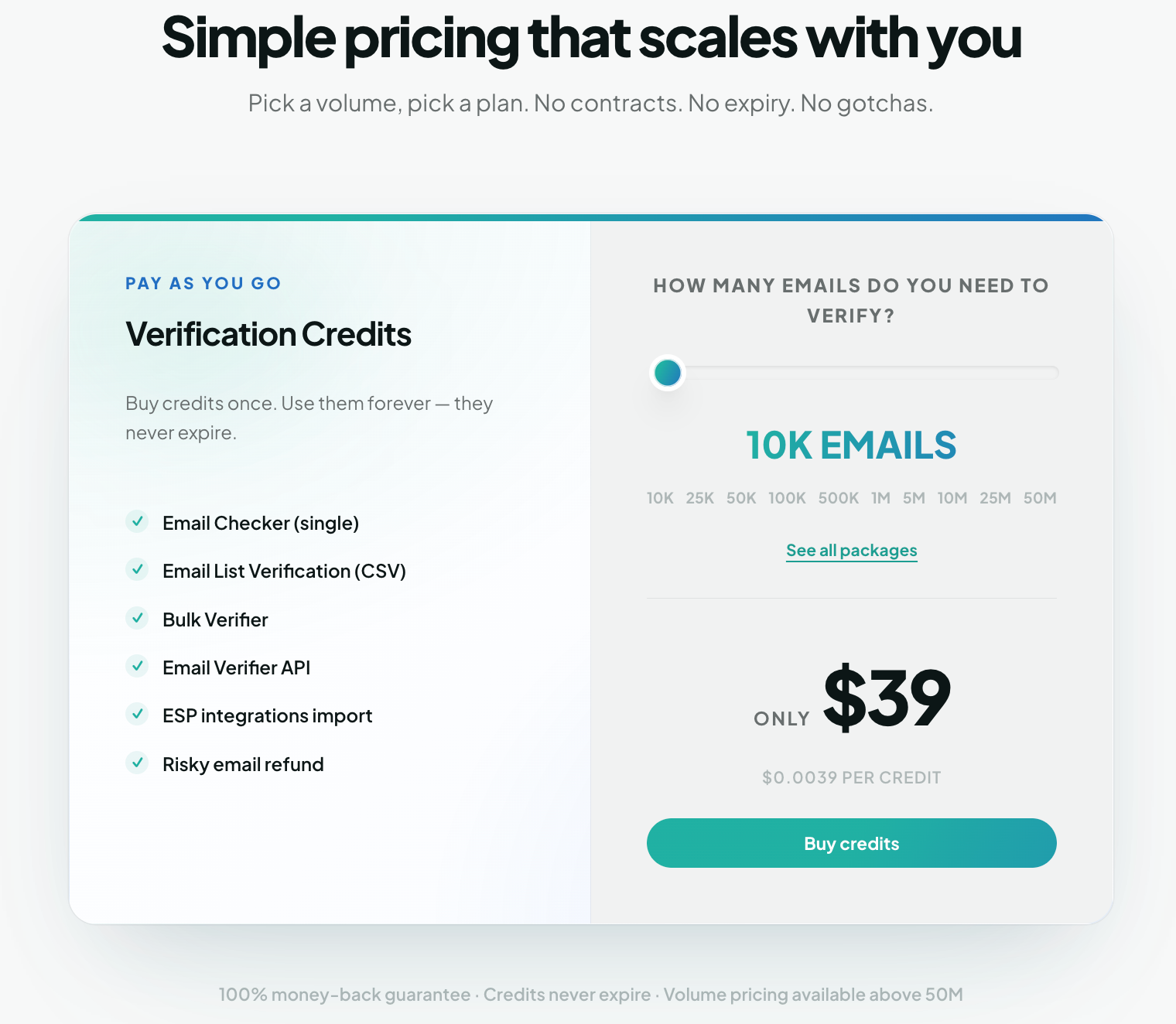
Pricing currently starts at $39 for 10,000 verification credits, with lower per-credit pricing available at higher volumes. Businesses can create a free account with trial credits before purchasing additional verification credits.
EverClean, MillionVerifier's automated list maintenance service, uses separate subscription pricing from standard verification credits.
Looking at each pricing model individually helps explain how the platforms work. The table below summarizes the main differences in pricing structure, credits, API access, and ongoing verification options.
Neither pricing model is universally better.
Listmint’s monthly plans may be easier to budget for when verification volume is steady, while MillionVerifier’s non-expiring credits may suit teams whose usage changes between campaigns.
This detailed comparison shows that the right choice depends on verification frequency, expected volume, API requirements, and any need for recurring list maintenance.
When comparing competitive pricing, consider how each platform fits your process instead of focusing only on the lowest entry price.
Every business verifies email addresses differently. Before choosing a platform, consider how often you verify contacts, the level of detail you need, and how your verification workflow may change over time.
Start by thinking about when verification happens in your business. If the goal is to clean a lead list before an occasional campaign, a straightforward upload-and-verify process may be all you need.
Businesses that collect new contacts every day often have different requirements. Verifying email addresses during lead collection, CRM updates, or ongoing database maintenance can help keep contact data accurate between campaigns instead of waiting until the next bulk verification.
Both platforms support bulk and real-time verification, so verification frequency should be considered alongside pricing, integrations, and catch-all result requirements.
Not all email verification platforms present catch-all results in the same way. While both Listmint and MillionVerifier support catch-all verification, the level of detail they provide may differ.
Review the verification statuses each platform returns and consider how your team will use them.
If your workflow involves frequent B2B prospecting, compare sample verification results to see how catch-all addresses are classified and whether the results provide enough confidence for your sending decisions.
If reducing your email bounce rate is part of your sender-reputation strategy, choose the output that gives your team enough information to decide which contacts to send to, review, or remove.
Consider how email verification may change as your database and campaigns grow.
Ask:
These questions help determine whether monthly usage, non-expiring credits, native integrations, or detailed catch-all classifications will be more valuable over time.
Think about how email verification fits into your existing process.
If your team mainly cleans email lists before occasional campaigns, a straightforward bulk verification workflow and flexible pay-as-you-go pricing may be enough.
If you verify new contacts continuously through forms, CRM systems, or custom applications, consider how each platform supports API-based verification, automation, and ongoing data quality.
The best choice is the one that fits naturally into the way your team collects, verifies, and manages email addresses.
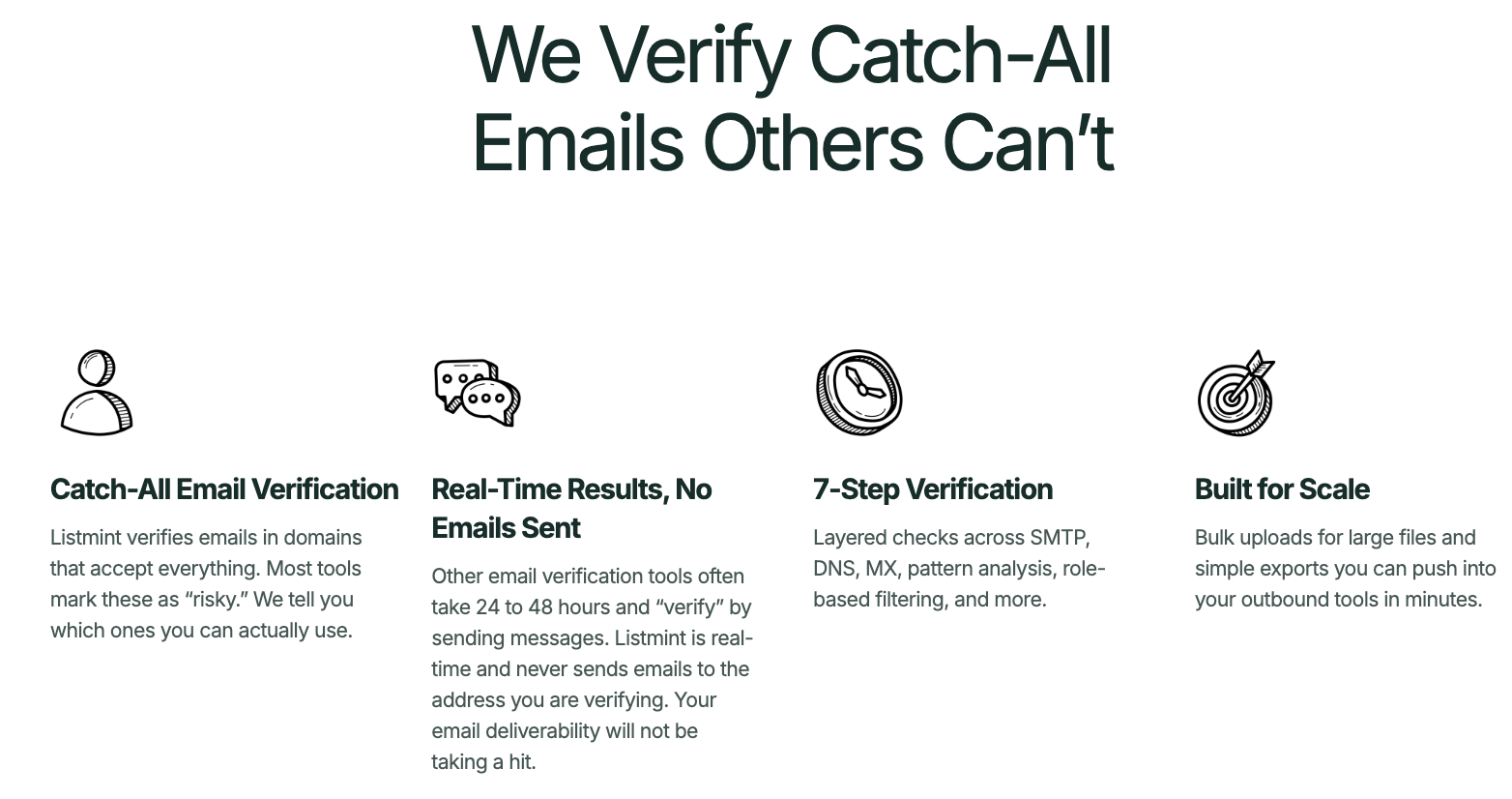
If your business regularly verifies B2B prospect lists or needs greater confidence when reviewing catch-all email addresses, Listmint offers more than standard email verification.
The platform combines bulk SMTP verification, real-time catch-all verification, and API-based workflows in one place.
Along with standard valid and invalid results, Listmint separates supported catch-all addresses into catch_all_valid and catch_all_invalid classifications, giving sales and marketing teams clearer information before sending campaigns.
Businesses can verify uploaded lists through the web application or connect the Email Verification API to forms, CRM systems, websites, and custom applications for real-time verification as new contacts enter their workflow.
Listmint is a strong MillionVerifier alternative for businesses that prioritize real-time catch-all verification and clear catch_all_valid or catch_all_invalid results. The best choice also depends on verification volume, pricing preferences, API and integration requirements.
Yes. MillionVerifier is a legitimate email verification service used by marketers, agencies, sales teams, and developers. It offers bulk verification, real-time API checks, native integrations, and automated list maintenance through EverClean to help identify invalid and risky addresses before sending.
The best email verification tool depends on the workflow. Listmint is a strong choice for real-time catch-all verification and clear catch-all classifications. MillionVerifier may suit businesses that prefer non-expiring pay-as-you-go credits, native integrations, bulk cleaning, and automated maintenance through EverClean.
As of July 2026, MillionVerifier advertises pay-as-you-go verification plans starting at $39. Larger packages are available, and purchased credits do not expire. EverClean uses separate subscription pricing.
Yes. MillionVerifier identifies and reports catch-all addresses as part of its verification results. Catch-all domains can still be harder to assess because they may accept messages for nonexistent mailboxes. Buyers should compare how each platform classifies catch-all results and how much certainty their process requires.