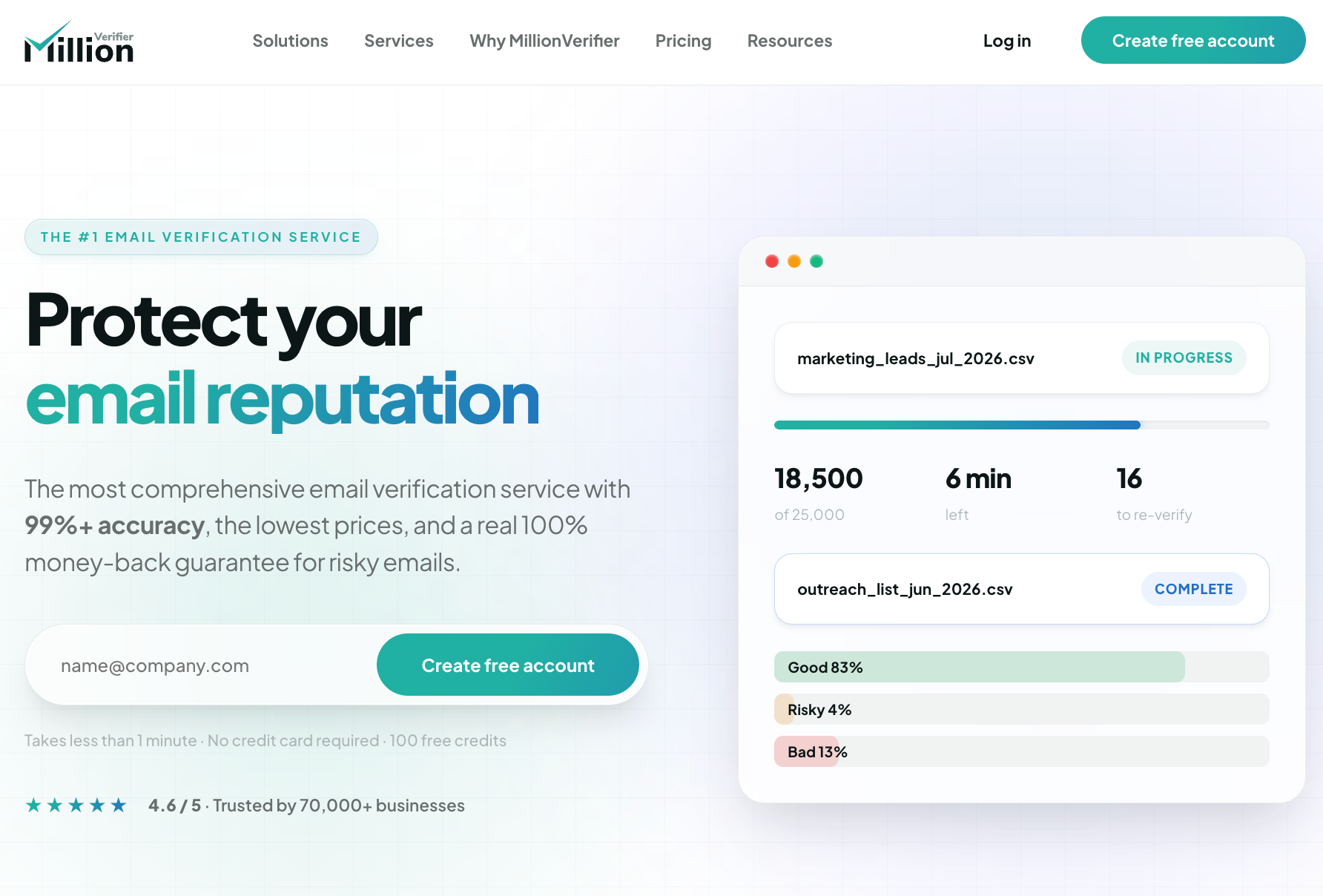
MillionVerifier is an email verification platform used by businesses to clean contact lists, identify invalid addresses, reduce email bounce rates, and help protect sender reputation.
However, no email verification tool fits every sending workflow, list size, or technical requirement.
Businesses often compare other platforms when they need more detailed verification results, real-time catch-all verification, API access, additional integrations, or a different pricing structure.
The right platform depends on how your team collects email addresses, manages contact data, and prepares lists for marketing or sales outreach.
This guide reviews the six best MillionVerifier alternatives and explains which types of businesses each platform may suit best.
These are the best MillionVerifier alternatives to consider in 2026:
MillionVerifier works well for many businesses, especially those that need straightforward list cleaning and a simple way to check large contact databases.
However, verification needs can change as a company collects more contacts, adds new workflows, or depends more heavily on automation.
That is often when businesses begin comparing alternatives with different result categories, API options, catch-all handling, and competitive pricing models.
Catch-all domains can accept messages for many recipient names, which makes it harder to confirm whether a specific mailbox exists.
A standard verification process may leave these contacts grouped as risky emails or unknown emails.
Teams working with B2B data may look for platforms that provide more specific results before those contacts enter an outreach list.
A broad good, risky, or bad result may not provide enough context for every business use case.
Marketing, sales, fraud prevention, and registration workflows may need disposable email and spam trap detection, email scoring, activity data, or other verification insights to support different decisions.
Teams may compare alternatives when they need more detailed and accurate results for the way they use contact data.
List cleaning may be enough for occasional email marketing campaigns, but businesses often need to check new email addresses as they are collected.
Real-time verification and validation through a single API can support forms, registrations, applications, CRM entries, and lead-capture workflows.
An API becomes more important once verification needs to happen before the address enters the main database.
Businesses do not all verify the same number of contacts or use credits at the same pace.
One company may prefer a monthly subscription, while another may need pay-as-you-go or credit-based pricing for occasional list cleaning.
Verification frequency, list size, and possible extra costs can influence which pricing structure feels practical.
Email verification platforms differ in how they process lists, classify results, support real-time workflows, and connect with other business systems.
The six tools below represent different approaches, from catch-all verification to developer-focused APIs and combined email discovery workflows.
Listmint is an email verification platform that combines standard SMTP verification with real-time catch-all verification.
Businesses can verify email lists directly through the platform, while software companies and verification providers can integrate Listmint's API to offer standard SMTP and real-time catch-all verification within their own products or services.
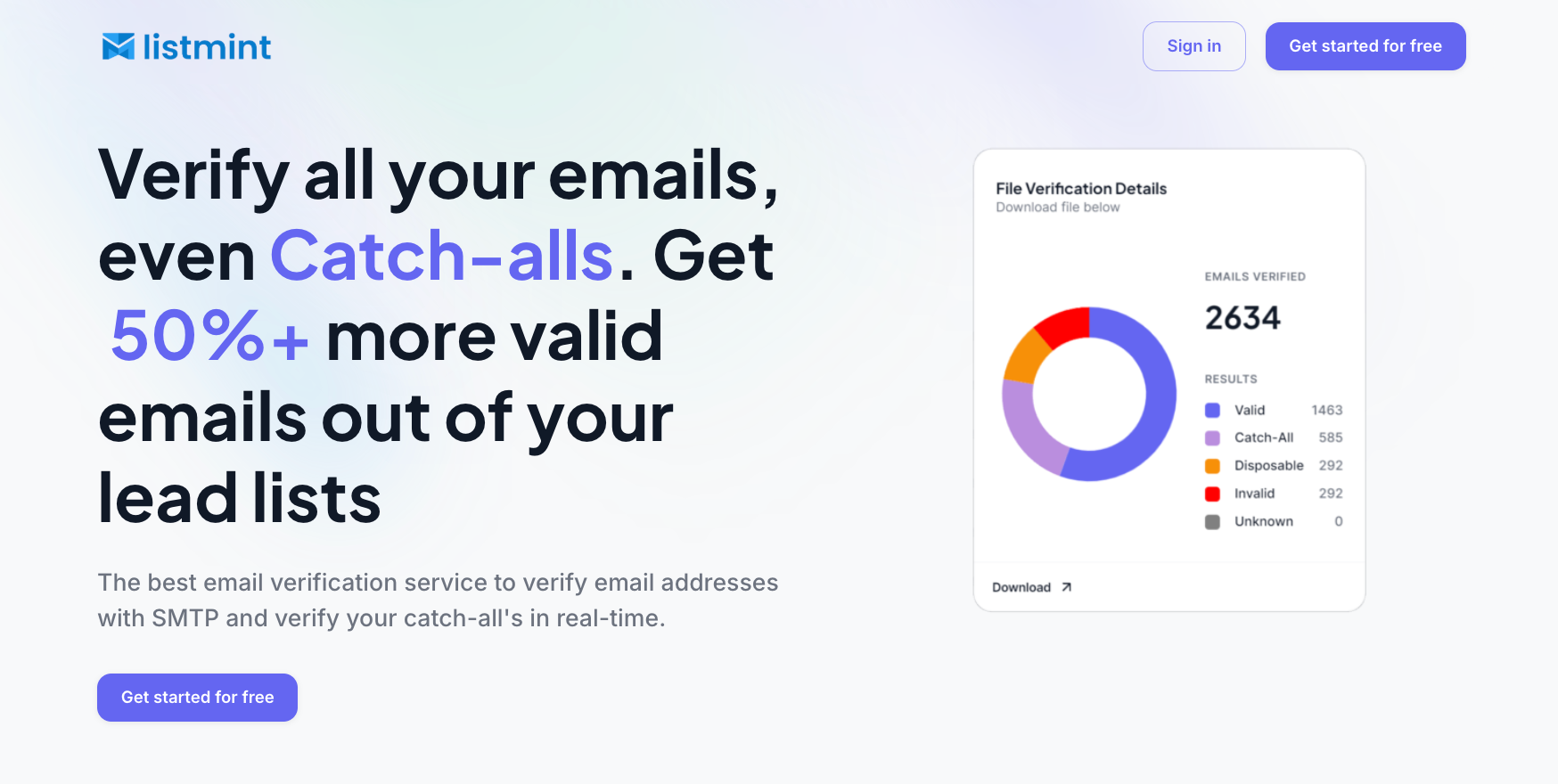
Listmint is ideal for businesses that work with B2B lead lists containing a high number of catch-all email addresses.
Standard email verification can identify that a domain is configured as catch-all, but it often cannot confirm whether the individual mailbox exists. Those addresses are left in a broad “catch-all” or “risky” category.
Listmint performs an additional real-time verification step for those addresses without sending an email to the recipient, returning each result as either catch_all_valid or catch_all_invalid.
This means teams do not need to treat verified catch-all addresses as uncertain. A catch_all_valid result can be handled like another valid email, while a catch_all_invalid result can be removed before outreach.
Listmint reports that 30% to 40% of a typical lead list may initially be classified as catch-all or risky by standard verification tools. Its additional verification process can help businesses recover more usable contacts from lists they have already paid for.
Plus, more than one billion email addresses have been verified through the platform, with over 99% SMTP verification accuracy and over 99% catch-all verification accuracy.
Businesses should estimate how many standard and catch-all email addresses they expect to verify before choosing a plan.
Listmint uses separate SMTP and catch-all credits because each verification process is performed independently. Teams should compare plans based on their expected verification volume and catch-all verification needs.
B2B sales teams, marketers, lead generation agencies, and software companies that need standard SMTP and real-time catch-all verification in one platform.
NeverBounce is an email verifier focused on helping businesses clean email lists through bulk verification, real-time validation, and automated list-maintenance workflows.
It is commonly used by marketing teams that regularly manage large email lists and want verification connected to their ongoing email operations.
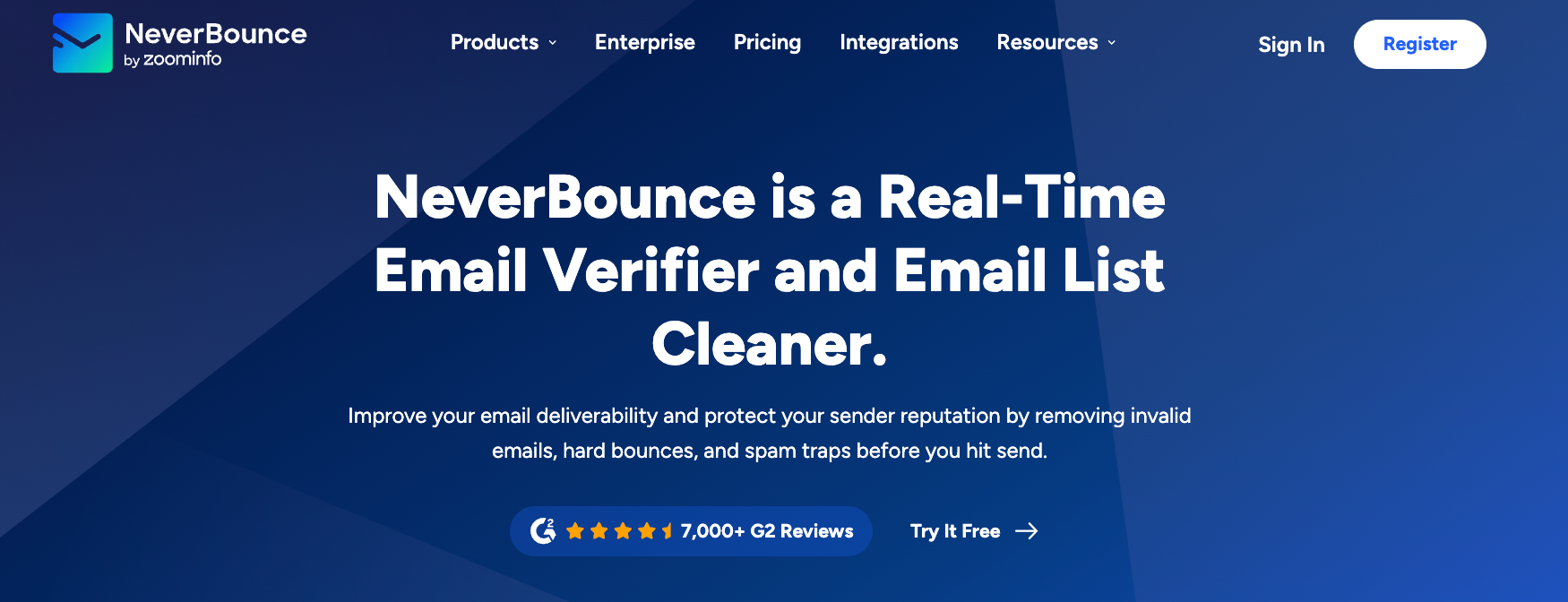
NeverBounce is suited for organizations that routinely verify large contact databases and keep subscriber lists up to date.
Its automated cleaning workflows and important integrations allow businesses to sync verification with existing marketing tools, making it a practical choice for maintaining verified lists over time.
Before choosing NeverBounce, compare its pricing for high-volume verification, review how it classifies uncertain email addresses, and confirm that its verification categories match your team's sending policies and reporting needs.
Marketing teams that regularly clean large lists and want verification connected to existing campaign systems.
Kickbox is an email verification platform that helps businesses validate email addresses before they enter a database or campaign.
It supports bulk verification, real-time verification through its API, and workflows that help marketers, developers, and product teams maintain cleaner email data.
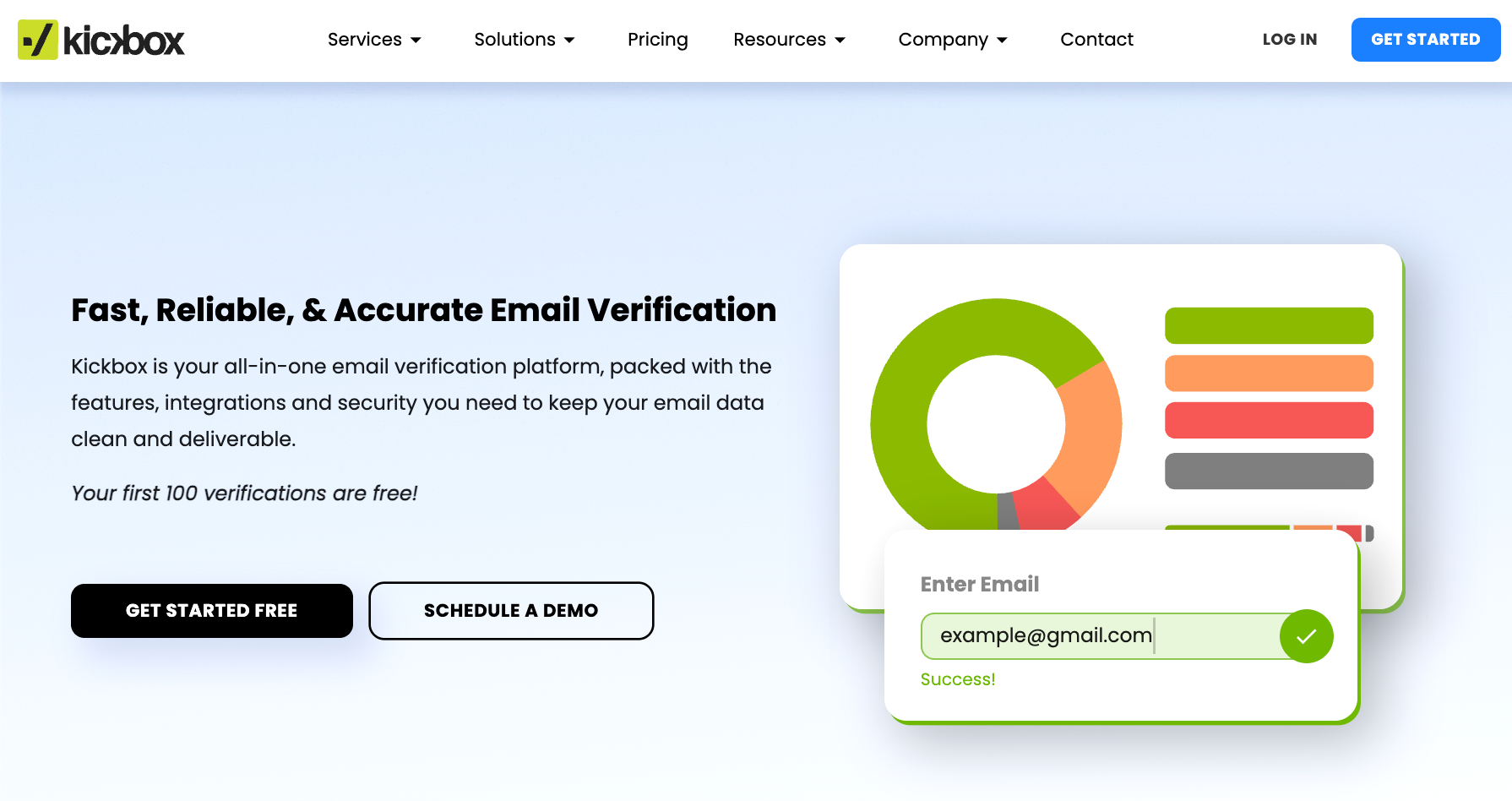
Kickbox focuses on verifying email addresses at the point of data collection.
Its API supports real-time verification for signup forms, registration pages, and applications, helping businesses prevent invalid, misspelled, and disposable email addresses before they enter customer databases.
This approach may appeal to product, engineering, and marketing teams that want verification built into customer-facing workflows.
Compare Kickbox's pricing page, available integrations, and how it classifies catch-all, risky, and other uncertain email addresses. These result categories may require teams to create their own rules for accepting or removing contacts.
Marketing teams and developers that need bulk and real-time email verification for forms, applications, and campaign workflows.
Verifalia is an email verification tool focused on configurable checks and technical control.
It supports bulk list cleaning, real-time API verification, detailed status codes, and adjustable settings for verification quality, timeouts, data retention, and callbacks.
Verifalia may suit technical teams that want enough detail to define their own verification rules.
Its API provides broad classifications and detailed status codes, giving developers greater control over how deliverable, risky, unknown, and undeliverable email addresses are handled.
The platform also supports web-form verification, software development kits, user permissions, and configurable security controls.
Review Verifalia's data-processing terms, retention controls, pricing, and integrations before adoption. Verifalia is not positioned as a complete deliverability platform, so teams needing broader email deliverability analysis may still require multiple tools.
Developers and technical teams that want detailed verification results and configurable API controls.
Hunter combines email finding with email verification in one platform. Its Email Finder helps users locate professional email addresses by name or company, while its verifier checks addresses before outreach.

Hunter combines prospect discovery with email verification, making it useful for sales and marketing teams.
Users can search company domains, find professional email addresses, verify results, and continue into outreach from the same platform.
It also offers Reverse Lookup, which can return available professional information linked to an email address. This may reduce the need to move between other tools during early prospecting.
Hunter is broader than a dedicated verification service, so compare its verification depth, result categories, and credit usage with your team's needs. Data coverage may also vary for smaller companies, newer businesses, and less common domains.
Sales and marketing teams that want email discovery, verification, and basic outreach tools in one platform.
Clearout is an email validation platform that also includes lead generation and data enrichment features.
Along with email verification, it offers other services such as email finding, LinkedIn prospecting, form validation, and lead enrichment to support broader sales and marketing workflows.

Businesses comparing verification platforms may choose Clearout when lead discovery and enrichment are also part of their workflow.
In addition to verifying email addresses, it supports email discovery, real-time form validation, LinkedIn-based lead capture, and contact enrichment.
This combination may reduce the need to switch between multiple applications during prospecting and list-building.
Organizations should compare verification results, pricing, and credit usage with their expected workload. Teams that only need email verification may also want to evaluate whether the platform's additional features align with their workflow.
Sales and marketing teams looking for email validation alongside lead generation and contact enrichment capabilities.
Once you have a shortlist, the next step is to compare how each platform performs in situations that match your everyday workflow.
Focus on the areas that will have the biggest impact on your business, from catch-all handling and verification volume to API performance and integrations.
Upload a representative sample that includes addresses from known catch-all domains and verify how each platform classifies them.
Compare the results to see whether the same contacts remain broadly risky or receive more specific classifications. The objective is to get a full picture of how each tool handles the same data.
Look at how many email addresses your business verifies in a typical month and how often those checks take place.
Compare file-size limits, processing capacity, credit expiration policies, and charges for unknown or unverifiable results.
If verification is part of your existing workflow, check whether the platform supports a bulk API alongside batch processing. If you're testing several options, see if free credits are available before committing to a paid plan.
Test the API using the same forms, CRM, or applications your business already uses.
Review the documentation, available SDKs, rate limits, and error handling before connecting it to your workflow.
Confirm that the returned status fields provide the information your workflow needs and consider how much ongoing maintenance the integration may require.
Look beyond the overall verification result and review how each platform labels valid, invalid, unknown, catch-all, disposable, role-based, and duplicate addresses.
Check whether exports explain why an address received its status and whether those results are easy to map to your internal sending rules.
Some providers include spam trap indicators, but no email verification platform can reliably identify every one with certainty.
Consider how the solution fits into your existing process. Review available integrations with your CRM, email platform, marketing automation software, and lead capture systems.
Also compare import and export options, automated list cleaning, and synchronization features to reduce duplicate records and unnecessary manual updates.
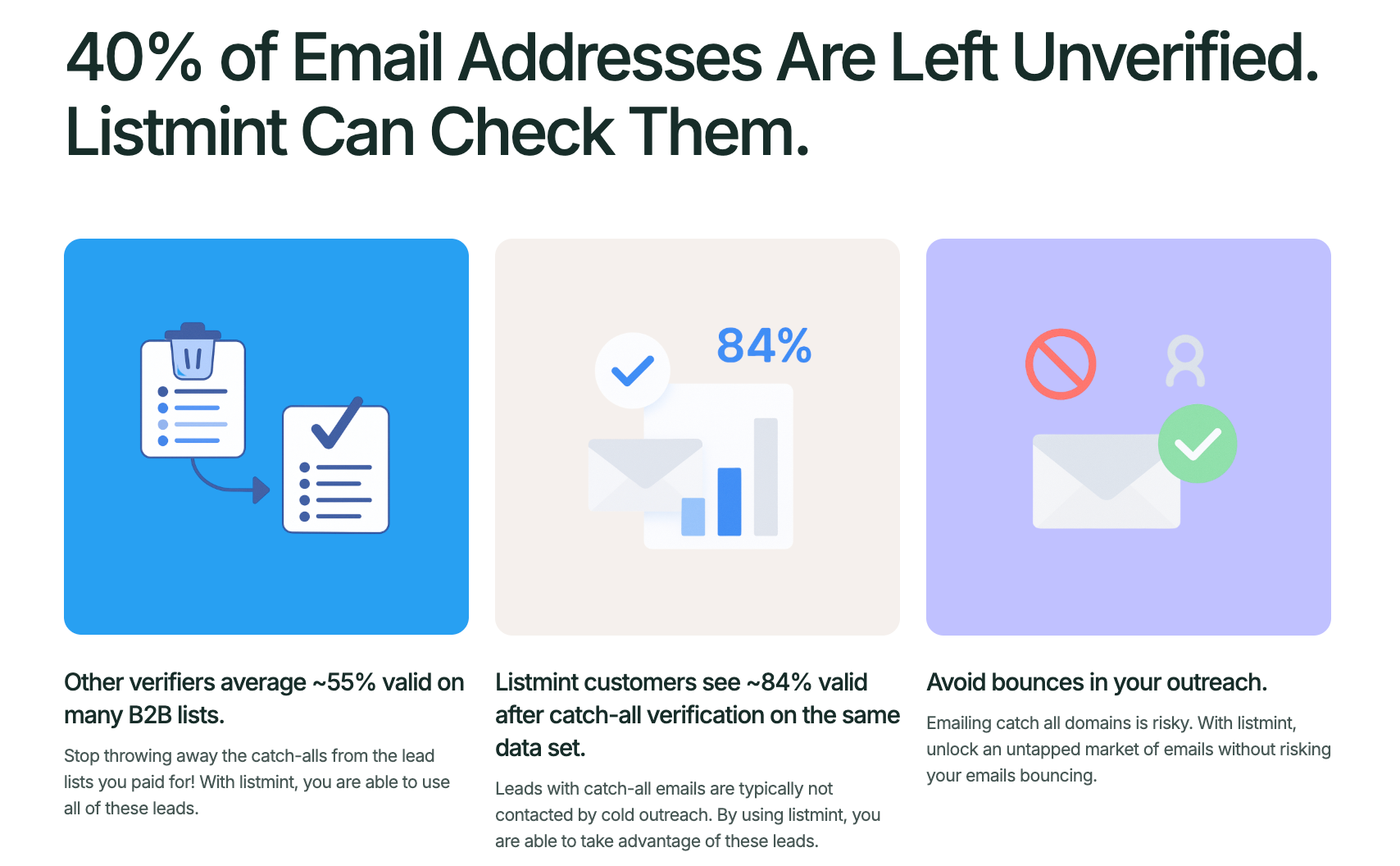
Choosing an email verification platform comes down to the features that are most important to your business. Compare how each tool handles bulk verification, API access, integrations, verification results, and catch-all email addresses before making a decision.
If real-time catch-all verification is a priority, Listmint is a popular email verification service that combines standard SMTP verification with catch-all verification in one platform.
The best email verification tool depends on your business needs. Some platforms focus on bulk email verification, while others specialize in API integrations, real-time verification, or catch-all email handling.
If your business relies on B2B lead lists, Listmint combines standard SMTP verification with real-time catch-all verification, making it a strong option for teams that want clearer verification results before sending campaigns.
Yes. MillionVerifier is a legitimate email verification platform used by businesses to identify invalid email addresses, reduce bounce rates, and improve email deliverability. It supports bulk email verification and API access, making it suitable for businesses that need to verify large contact lists before outreach.
There is no single email finder that is the most accurate for every use case. Tools such as Hunter, Clearout, Apollo, and Findymail use different data sources and verification methods, so results can vary.
After finding email addresses, many businesses use a dedicated email verification tool like Listmint to confirm deliverability before sending campaigns.
Many email lookup tools offer free plans or limited monthly searches, including Hunter and Apollo. The best choice depends on whether you need email discovery, email verification, or both.
If you already have a list of email addresses, a dedicated email verification tool like Listmint is a better choice for checking email deliverability and identifying catch-all email addresses before outreach.
Yes. Many providers offer budget-friendly email verification plans for small businesses, agencies, and growing teams. Compare pricing, included verification credits, API access, and available features to find the solution that best matches your verification needs.