You might have 10,000 contacts in a file, yet the number that can actually receive your next campaign could be smaller. NeverBounce checks each address before you send and separates contacts based on the result it receives from its verification process.
Bulk cleaning works for existing lists, real-time checks can screen new leads, and API access lets software run verification automatically. Catch-all and unknown results need extra attention since neither gives the same answer as a confirmed valid mailbox.
In this NeverBounce review, you’ll learn how NeverBounce works, what you get for the price, and how to read its results.
NeverBounce is an email verification platform that cleans email lists and checks whether the addresses in your database can receive messages.
If you send marketing or sales emails, invalid contacts can raise your bounce rate and weaken your sender reputation because messages keep going to inboxes that no longer exist.
As an email verifier, NeverBounce checks those records before you use them in a campaign, which helps you protect sender reputation from bad contact data.
NeverBounce organizes its core features around Clean for bulk lists, Verify for new contacts, and Sync for connected lists that need regular checks.
You can upload an email database for cleaning or check addresses as people submit them through forms and other software. Knowing how NeverBounce handles these tasks helps you choose the right method for existing contacts and new email leads.
Finding reliable email verification gets easier when you know how NeverBounce cleans full lists, checks new form entries, and connects verification to your own software. These key features provide all the details you need to decide whether paying for a full clean makes sense:
NeverBounce bulk email verification, called Clean, focuses on bulk processing for contact lists you already have.
You can upload a CSV file or send list data through the API, then NeverBounce checks the addresses and sorts the results into valid, invalid, catch-all, disposable, and unknown groups.
Before verification starts, NeverBounce removes duplicates and catches records with bad syntax. You don’t pay verification credits for those entries. Its free analysis can also sample your list first and estimate its bounce rate, so you have an idea of its condition before you pay for a full check.
During the verification process, NeverBounce checks signals from the email domain and mail server to find invalid email addresses. You can track the entire process as the job runs.
Processing speed depends on the list and remote servers. Removing invalid emails before you launch email marketing campaigns can reduce avoidable bounces.
NeverBounce’s real-time email verification, called Verify, checks individual addresses as people enter them into your forms. Instead of cleaning the list later, you can verify emails at the point of entry and stop known bad data from reaching your records.
For website forms, NeverBounce provides a JavaScript widget that detects email fields and checks the address during the submission process. You can change what your form accepts.
For example, you may allow valid addresses and reject disposable ones, such as temporary inboxes someone creates to claim an offer and leave.
Checks can catch basic mistakes such as a missing “@” sign or a misspelled domain like “gmial.com.” That makes the feature useful for lead capture forms where a simple typing error can leave you with an unusable contact.
NeverBounce’s API connects its verification service to custom software, mobile apps, registration forms, and automation tools.
Developers can use the “/v4/single/check” endpoint to send one address from their server and receive a result without opening the NeverBounce dashboard. Sales professionals can use this type of setup when their sales system needs to check new contacts automatically.
You don’t have to build every connection from scratch. NeverBounce currently provides SDKs for:
Authentication uses a private API key that you create in your NeverBounce account and add to your server-side code. NeverBounce warns against exposing private credentials in browser code.
You can use these connections to add email verification tools to custom marketing tools and other applications. Bulk jobs can create a list, submit the data, start verification, check progress, and retrieve the finished results automatically.
NeverBounce’s free list analysis checks a sample of your list and estimates its bounce rate before you spend money on full verification. You can use it without paying for the complete cleaning job first.
The process works in three steps:
NeverBounce removes duplicate addresses during list preparation, and those repeated contacts don’t cost verification credits. New accounts can include free test credits for testing the service.
It doesn’t provide a forever-free plan for ongoing verification, but its list analysis gives you a limited free trial of list health.
NeverBounce’s integration capabilities connect its verification service with CRM, email marketing, forms, and other apps where you keep contact data.
Supported integrations let NeverBounce connect directly with platforms such as HubSpot and Mailchimp instead of making you export and upload a new file for each cleaning job.
For recurring checks, the sync feature links NeverBounce with a supported CRM or email service provider. NeverBounce Sync checks connected contact lists on a schedule, so it’s useful for ongoing list hygiene as addresses become old or new records enter your database.
Through that setup, you can turn repeated list checks into automated cleaning rather than a manual export, verification, and import routine.
No-code services can connect other apps to the same process. For example, you can create a workflow that sends a new Google Forms address to NeverBounce, checks it, and writes the verification result to a chosen Google Sheets column.
When NeverBounce finishes checking your list, it gives each address one of five results: Valid, Invalid, Accept-All, Disposable, or Unknown. Each label tells you what the system found and how much confidence you can place in that contact.
NeverBounce presents these groups through a user-friendly interface that makes them easier to separate before sending.
Cleaning known bad contacts can reduce bounce risk, but it doesn’t guarantee that every message will avoid the spam folder.
NeverBounce checks an address by connecting with the recipient mail server and asking whether it can accept mail for that user. No normal email needs to reach the inbox during this check.
Domain, DNS, MX, SMTP, disposable, and accept-all signals give the system more information than a basic syntax test.
NeverBounce claims high accuracy for its verification service, but no result removes every source of uncertainty. Catch-all servers can accept every username without confirming the actual mailbox, and temporary server problems can return an unknown result.
Those limits are important when you use verification to improve email deliverability, lower your bounce rate, and protect your sender reputation.
Spam traps create another problem because some are working inboxes created to identify unwanted senders. NeverBounce does include a known spam-trap-network signal in its API, yet spam trap detection can’t identify every hidden trap.
Major email service providers use many other signals when deciding whether to accept, filter, or reject a message.
NeverBounce uses transparent pricing based on how many email addresses you need to check, with a pay-as-you-go option for one-time cleaning and monthly plans for regular use.
Pay-as-you-go pricing starts at $8 for 1,000 verifications, or $0.008 per address. One credit covers one verification, and the price per check drops as your volume rises.
As you go into larger credit packages, the lower unit cost can make more sense for high-volume marketing teams. Purchased credits expire after 12 months.
The Growth plan starts at $49 per month for up to 10,000 emails and includes premium features such as NeverBounce Sync. Companies with much larger needs can contact NeverBounce about an enterprise package with custom pricing.
NeverBounce focuses on verification rather than inbox placement testing, so teams that need detailed inbox placement data may use separate deliverability tools.
NeverBounce handles catch-all emails by keeping them separate from confirmed valid results and marking them as accept-all or catch-all. An accept-all result means the domain accepts messages sent to usernames even when NeverBounce can’t prove that the individual mailbox exists.
Many companies configure accept-all domains this way to avoid rejecting messages sent to an unexpected address. For example, “john@company.com” and “madeup123@company.com” may receive the same positive server response even when only one mailbox exists.
NeverBounce checks the email domain and communicates with its server without sending a normal message. With catch-all domains, the server keeps accepting the test regardless of the username, leaving the individual inbox unresolved.
For email marketers, these contacts need a separate sending decision rather than automatic approval. Your list quality and risk tolerance should guide whether you keep them, test a smaller segment, or leave them out. This is where a tool like Listmint comes in handy.
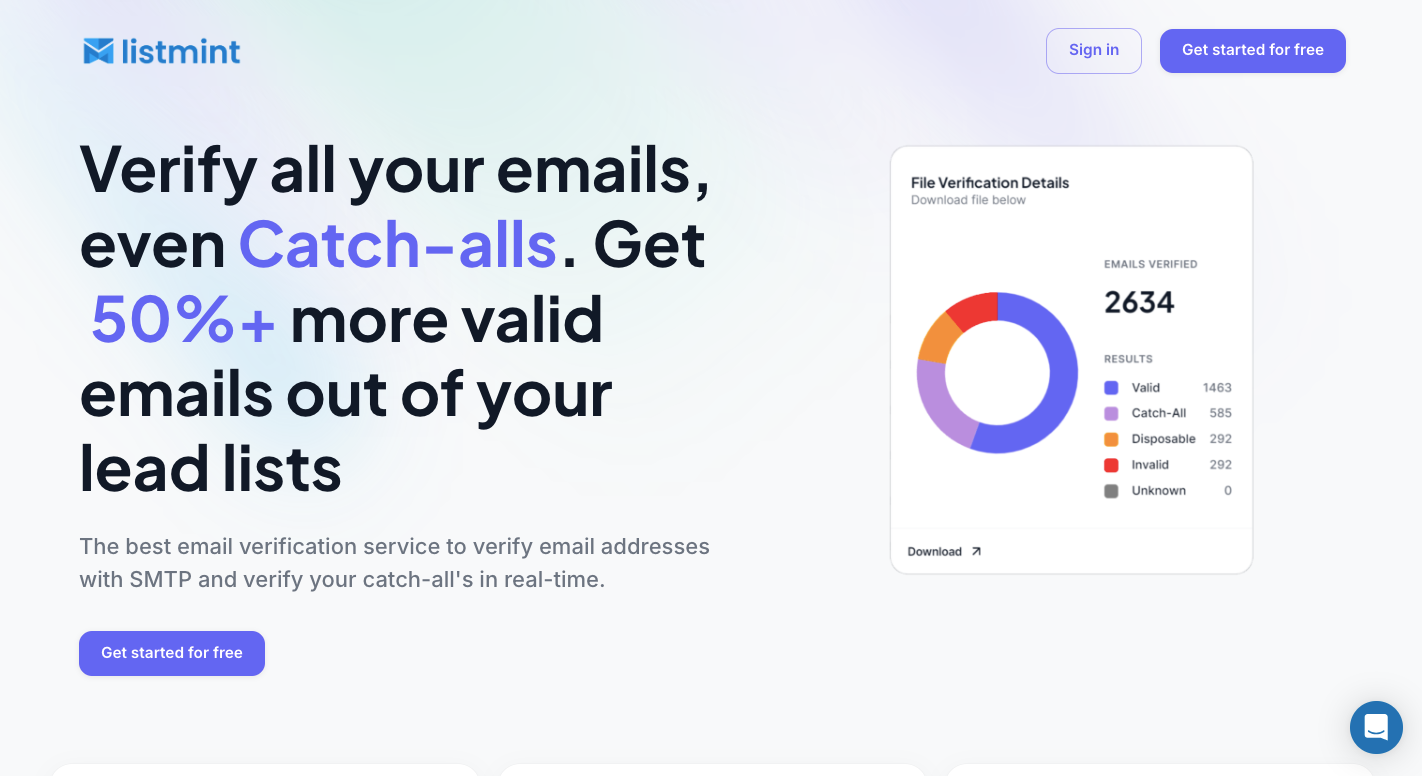
Listmint checks standard addresses and catch-all emails in the same platform, so B2B teams have a way to clean a list without moving uncertain contacts to a separate verification service.
Listmint starts the email verification process with standard SMTP checks. It separates addresses into valid, invalid, and catch-all results based on the response from the recipient’s mail server.
Catch-all addresses need another check because their domains can accept requests for usernames that don’t actually have mailboxes. Listmint runs an additional verification step on those contacts instead of leaving every one of them under a general risky label.
Listmint provides real-time verification for catch-all addresses without sending an actual email to the recipient. Results don’t require the 48-hour waiting period associated with slower catch-all verification methods.
For example, a standard SMTP check may find that “john@company.com” belongs to a catch-all domain. Listmint can run its additional check and determine whether that address should remain in the usable group.
B2B teams can upload a lead list directly to Listmint for bulk verification. Standard SMTP checks run first, then the platform identifies addresses that need catch-all verification.
Listmint uses separate credits for each process because catch-all checks cost more than standard verification.
Starter includes 20,000 standard credits and 5,000 catch-all credits for $99 per month. Agency costs $187 per month and includes 50,000 standard credits plus 10,000 catch-all credits.
Companies can connect Listmint’s API to forms, websites, applications, and other products instead of manually uploading each list.
API requests return results for regular and catch-all addresses in real time. Listmint doesn’t send verification emails to the contacts being checked, which makes the API suitable for software that needs an answer as soon as a user submits an address.
Listmint’s API isn’t limited to businesses checking their own contact databases. B2B2C companies can integrate regular and catch-all verification into products they provide to customers.
A lead generation platform, for example, can send an address to Listmint through its own software and return the verification result to its customer. That setup lets the company provide verification without building the underlying checking system itself.
NeverBounce pricing depends on verification volume and plan type. Its pay-as-you-go option uses credits for individual email checks, with lower per-address rates at higher volumes.
ZeroBounce and NeverBounce serve different needs. ZeroBounce includes additional deliverability features such as inbox placement tests and blacklist monitoring, whereas NeverBounce focuses heavily on email verification and list cleaning.
NeverBounce is an email verification service that checks email addresses before you send to them. It examines domains, mail servers, and mailbox responses to classify contacts as valid, invalid, catch-all, disposable, or unknown.
ZeroBounce uses encrypted files, two-factor authentication, role-based access controls, and automatic file deletion. It also reports SOC 2 Type 2 and ISO 27001 certification.