Email verification sounds like a simple expense until you start comparing prices.
One email verification service might charge per credit, while another offers monthly plans or custom rates based on how many emails you need to check.
Even when two plans cost about the same, the number of verifications included can be very different.
And since keeping a healthy sender reputation and improving inbox placement are already priorities for many businesses, you want to know exactly what you're paying for.
Understanding email verification pricing can help you avoid paying for more than you need.
In this guide, we'll look at how email verification pricing works, compare published provider rates, and show you how to calculate the cost for your own list.
Email verification services generally offer three pricing models. The right option depends on how often you check email addresses and how many you need to verify.
With pay-as-you-go pricing, you purchase verification credits upfront and use them whenever you need to check email addresses.
Typically, one credit covers one standard email check, although the exact usage rules depend on the provider. You can purchase a set number of credits without committing to a recurring payment.
This model offers flexible pricing if you only clean your contact lists occasionally or use verification as part of your email deliverability efforts.
Check the minimum purchase requirement before buying credits. A free account, when available, lets you test the service first.
A monthly subscription gives your business a set verification allowance for a recurring fee. It works well when you regularly check new contacts or manage a steady volume of emails.
For example, if your website checks every email address a user enters into a signup form, those checks can count toward your monthly allowance.
Checking email addresses during data entry helps catch common mistakes before they end up in your contact database.
If you exceed your allowance, your provider may offer additional credits or require a plan upgrade.
Businesses verifying large lists or handling substantial daily volumes may qualify for custom volume pricing.
These arrangements typically involve negotiated rates, minimum commitments, and verification limits based on expected usage.
Higher API limits or additional enterprise-grade security features may also affect the quote if they require a custom arrangement.
The final terms depend on the provider and your business requirements.
Not sure which pricing model fits your needs? The table below shows when each option makes the most sense.
The price you see on a provider's website may not reflect what your business actually pays. Several factors can change the final cost, even when two services advertise similar rates.
How many emails you need to check is one of the biggest pricing factors.
Providers often offer volume discounts, meaning the cost per email decreases as you purchase larger credit packages. A high-volume purchase may have a lower rate than checking a smaller email list.
However, buying more credits than you need can still leave you spending more overall.
Not every address requires the same email verification process.
Standard checks are usually covered by regular verification credits. Catch-all addresses can require additional checks because their mail servers may accept messages without confirming a specific mailbox.
Depending on the provider, deeper catch-all verification may use additional credits or come at an extra cost. Check what the advertised rate covers before purchasing.
Pay attention to what happens to unused credits.
With certain providers, credits never expire, so you can save them for future checks. Other services set an expiration date or reset your allowance each month.
If your credits expire before you use them, you've paid for checks you can no longer make. Check if unused credits roll over to the next billing period or disappear when your plan renews.
Not every provider deducts credits for the same verification results.
For example, invalid addresses may still count as completed checks, but unknown results or duplicate entries may be handled differently.
Before purchasing, review how the provider charges for uncertain results, especially when checking risky emails in your customer data.
The advertised rate may not include every expense.
Annual billing can lower the monthly price but requires a longer commitment. Additional services such as data enrichment, email scoring, or activity data may be part of a broader product package or require separate payment.
Check for hidden costs, including API usage fees, overage charges, and applicable taxes.
It's also worth checking if a trial requires payment details, if the provider accepts major credit cards, and if the provider offers a full refund under specific circumstances.
The cost of an email verification tool can vary depending on the number of checks included and how the provider charges for them.
To make the comparison easier, the table below shows published rates for bulk email verification from six providers, including Listmint. It also highlights important pricing differences that may affect what you actually pay.
Pricing reviewed October 22, 2026, using published provider pricing pages. Prices are in USD. Package sizes and billing models differ, so the rates are not a direct price ranking.
Cost per 1,000 uses the listed price and credit quantity. Listmint and ZeroBounce subscriptions include different verification allowances or bundled services, preventing a direct comparison. DeBounce’s $0.90 rate covers standard checks using one credit each.
The table shows why the advertised price alone isn't enough. A lower rate per 1,000 may require purchasing a much larger credit package.
When comparing other providers, check the number of verifications included and what each purchase covers. That gives you a better idea of what email validation will actually cost your business.
Package rates show the cost per included check. Your effective rate depends on how many checks you use during the period being measured.
Effective cost per 1,000 checks = (Amount paid for the period ÷ Checks used during that period) × 1,000
Here's how that works in three common situations.
Say you purchase 10,000 credits for $60 to verify emails from one of your uploaded lists.
If you use all 10,000 credits for bulk verification, your cost is:
($60 ÷ 10,000) × 1,000 = $6 per 1,000 emails
You're paying $60 for the entire list, with no unused credits in this example.
Suppose your monthly plan costs $100 and includes 50,000 checks, but you only use 25,000 to check email addresses.
Your actual verification cost is:
($100 ÷ 25,000) × 1,000 = $4 per 1,000 emails
This is the effective rate for that month. If unused credits roll over and you use them later, the rate over a longer period may be lower. Even though your plan includes more checks, the effective rate depends on how many you actually use.
Imagine you need 20,000 standard checks at $0.002 each and 5,000 catch-all checks at $0.01 each.
Your costs would be:
Total cost of standard and catch-all verification: $90
These are hypothetical rates. When checking your own costs, use the provider's actual rates for each verification type.
Listmint combines standard SMTP and catch-all verification in one platform, so your business can handle both types of checks without purchasing separate verification tools.
Unlike basic verification tools that leave catch-all addresses marked as risky or uncertain, Listmint verifies these addresses in real time and returns more useful results.
That means you can identify more valid B2B contacts and flag bad data in the lead lists you've already paid for.
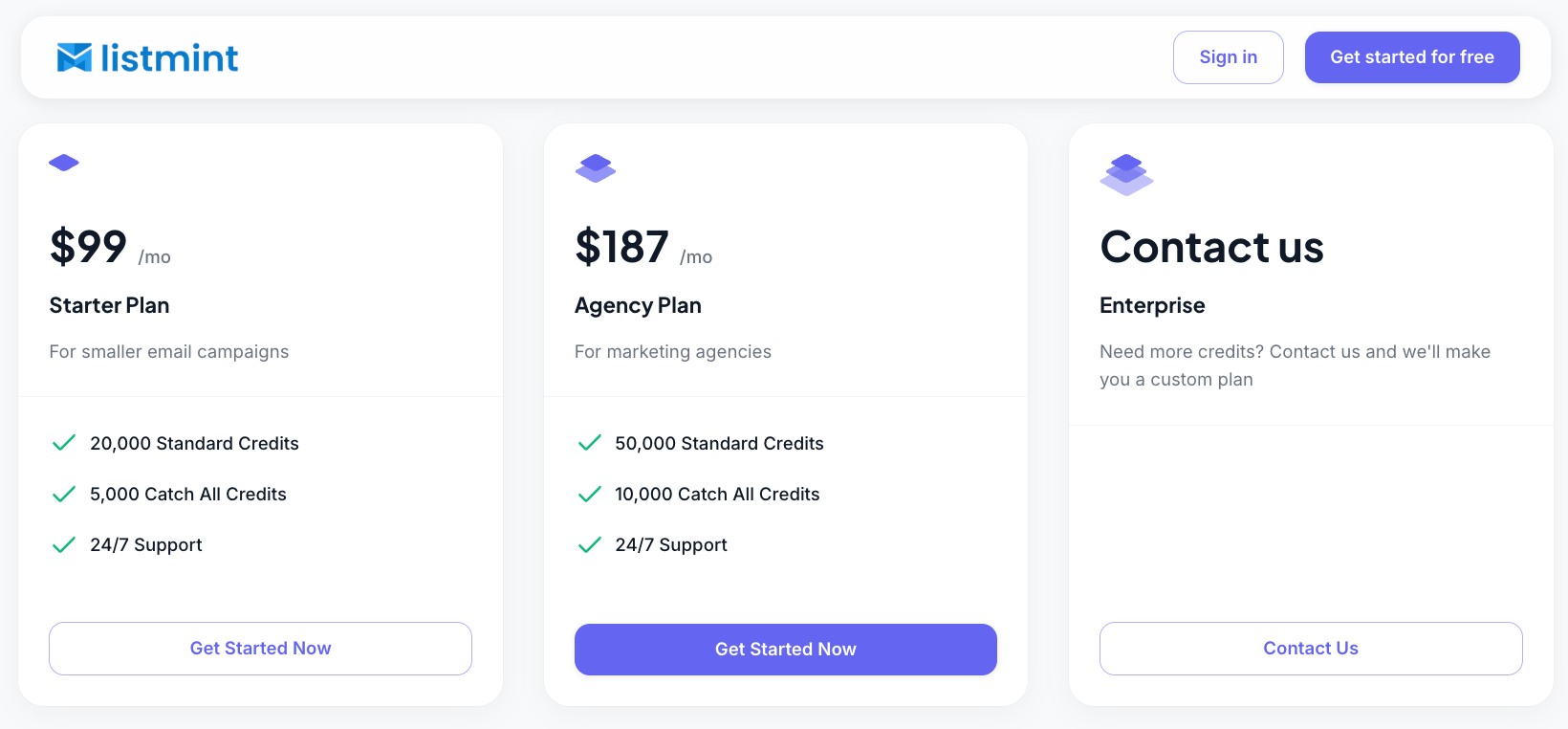
Listmint offers three pricing plans based on your verification needs. The Starter Plan costs $99/month and includes 20,000 standard credits and 5,000 catch-all credits, making it suitable for smaller email campaigns.
For agencies handling more contacts, the Agency Plan costs $187/month, with 50,000 standard credits and 10,000 catch-all credits. Both plans include 24/7 support.
Businesses that need higher verification volumes can contact Listmint for a custom Enterprise plan.
Standard SMTP and catch-all verification use different processes. Catch-all checks cost more to perform, so Listmint keeps the two credit types separate.
You pay for the verification capacity you need without using higher-cost catch-all credits for standard addresses.
Listmint also supports bulk checks and real-time verification through its API. Businesses can integrate real-time API verification into their workflows, including applications that need a REST API to check email addresses.
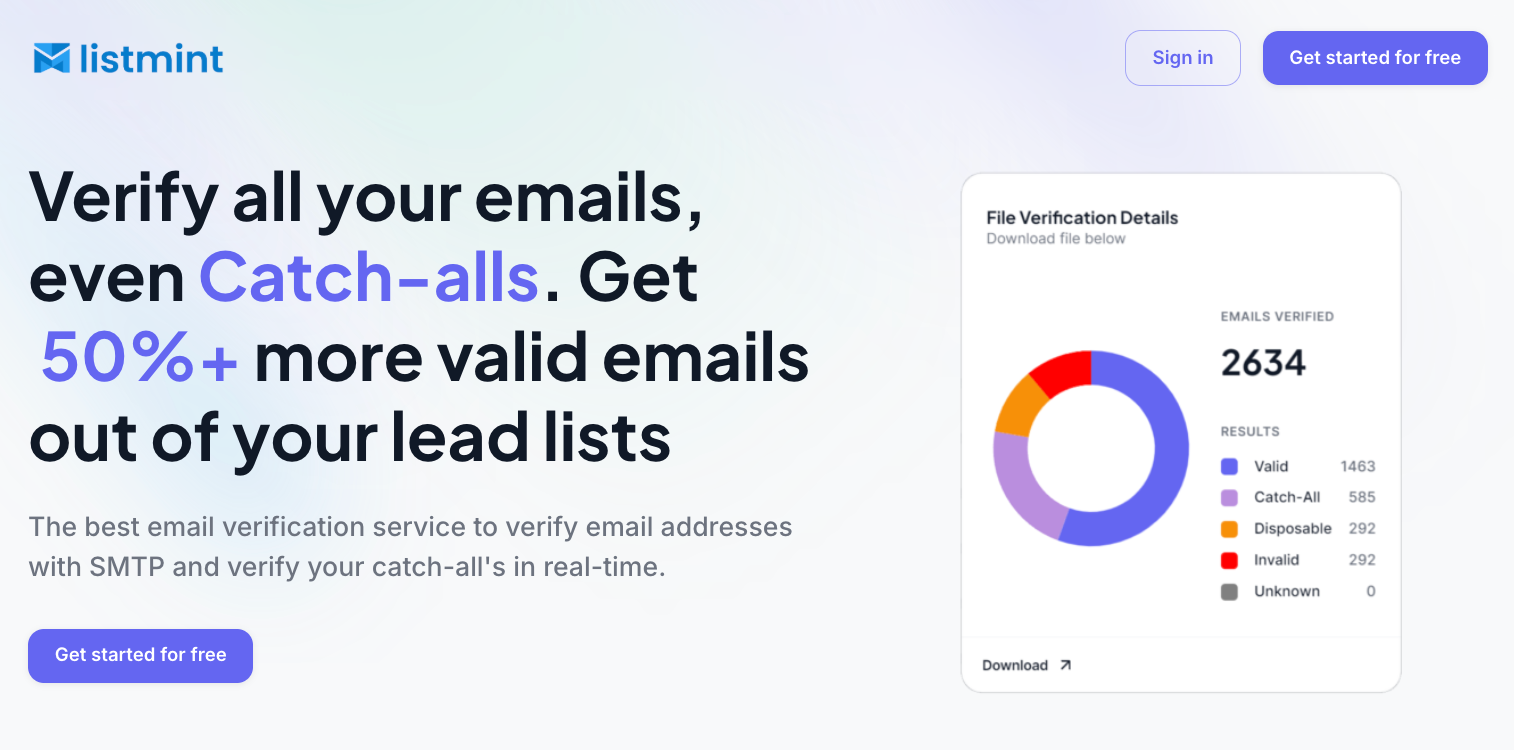
With 99%+ claimed accuracy for both SMTP and catch-all verification, Listmint helps businesses improve data quality and reduce the risk of a high bounce rate. Its dedicated catch-all verification can also identify valid contacts that other tools leave unresolved.
For businesses working with B2B prospect lists, that means getting more usable contacts from the same list without automatically discarding catch-all addresses.
Get more value from the lead lists you've already paid for. Choose a Listmint plan that fits your verification needs and make every credit count.
Explore Listmint's pricing plans and start verifying.
Choosing an email verification service isn't just about finding the lowest price. You also need to know how many checks you're paying for, what each plan includes, and how those costs fit your usual workflow.
For businesses working with B2B contact lists, Listmint offers a way to verify standard and catch-all addresses in one place, with separate credits for each type of check.
You can choose a plan that fits your verification needs and make better use of the contacts you've already collected.
Get started with Listmint for free and see how many of your contacts you can verify.
The cheapest email verification service isn't necessarily the one with the lowest advertised rate. Your actual spending depends on the number of emails you verify and what each plan covers. Compare providers at the same volume and check for additional charges before deciding.
Kickbox offers 100 free verifications, and ZeroBounce provides 100 monthly credits for eligible free accounts. Both are options worth considering if you want to test a service before paying. Check the free tier limits and whether a credit card is required before signing up.
The cost of sending 10,000 emails depends on your email sending platform and plan. Email verification is a separate expense. For example, Bouncer charges $60 to verify 10,000 addresses under its published pay-as-you-go pricing. That price doesn't include sending the emails.
The 60/40 rule is an informal email design guideline that suggests using about 60% text and 40% images. It isn't a requirement, and following that ratio won't guarantee better email reputation or inbox delivery.
Yes. A service that checks both standard and catch-all addresses can be the only email verifier your business needs.
Listmint offers both types of verification in one platform, with separate credits for each. Its subscription pricing starts at $99/month for 20,000 standard and 5,000 catch-all credits.