Catch-all domains create some of the hardest decisions in B2B email marketing.
A lead list can pass checks from a standard email verification tool and still create problems once email campaigns start. Risky emails can bounce, deliverability can drop, and sender reputation can suffer.
The challenge is that catch-all domains can accept messages for almost any address. That makes it difficult to confirm which mailboxes actually exist and which messages reach a valid address that may belong to a real person.
A standard verification tool may detect the catch-all domain but leave the address labeled as risky or unknown. Your team is then left deciding what is safe to send.
This guide compares five catch-all email verifier tools for B2B teams, looking at how each one handles these uncertain addresses and where it fits into the verification process.
These are the best catch-all email verifier tools for B2B teams in 2026:
Detection alone is not enough. You need to decide if an address is safe to send to, needs review, or should be suppressed.
A catch-all verifier should help make that call on hard-to-check addresses. Catch-all verification should go beyond flagging a catch-all inbox and move closer to confirming if the email exists.
A catch-all mail server may accept mail sent to almost any address. Because the server accepts those requests, the domain appears valid to a basic check even when a specific mailbox does not exist. This can leave results in risky or unknown buckets.
Useful results help teams make informed decisions before outreach. Single checks work for individual records, while bulk email verification upload lets you process a whole list.
API integration can also verify addresses inside forms, CRMs, and backend systems before records move forward.
Email deliverability still depends on what you send. Poor verification can increase bounce rates, leave questionable addresses in campaigns, and make messages more likely to be filtered as spam.
A practical verification process helps teams decide what to keep and remove before sending.
The right solution depends on how your business handles catch-all emails, verification volume, and outbound workflows. Below are five catch-all email verifier tools to consider in 2026.
Listmint is built for teams that want more usable results from email verification, especially when catch-all domains make individual addresses difficult to confirm.
Many tools can remove obvious invalid emails. The problem starts when a lead list contains catch-all domains and the results still leave your team guessing whether the email exists.
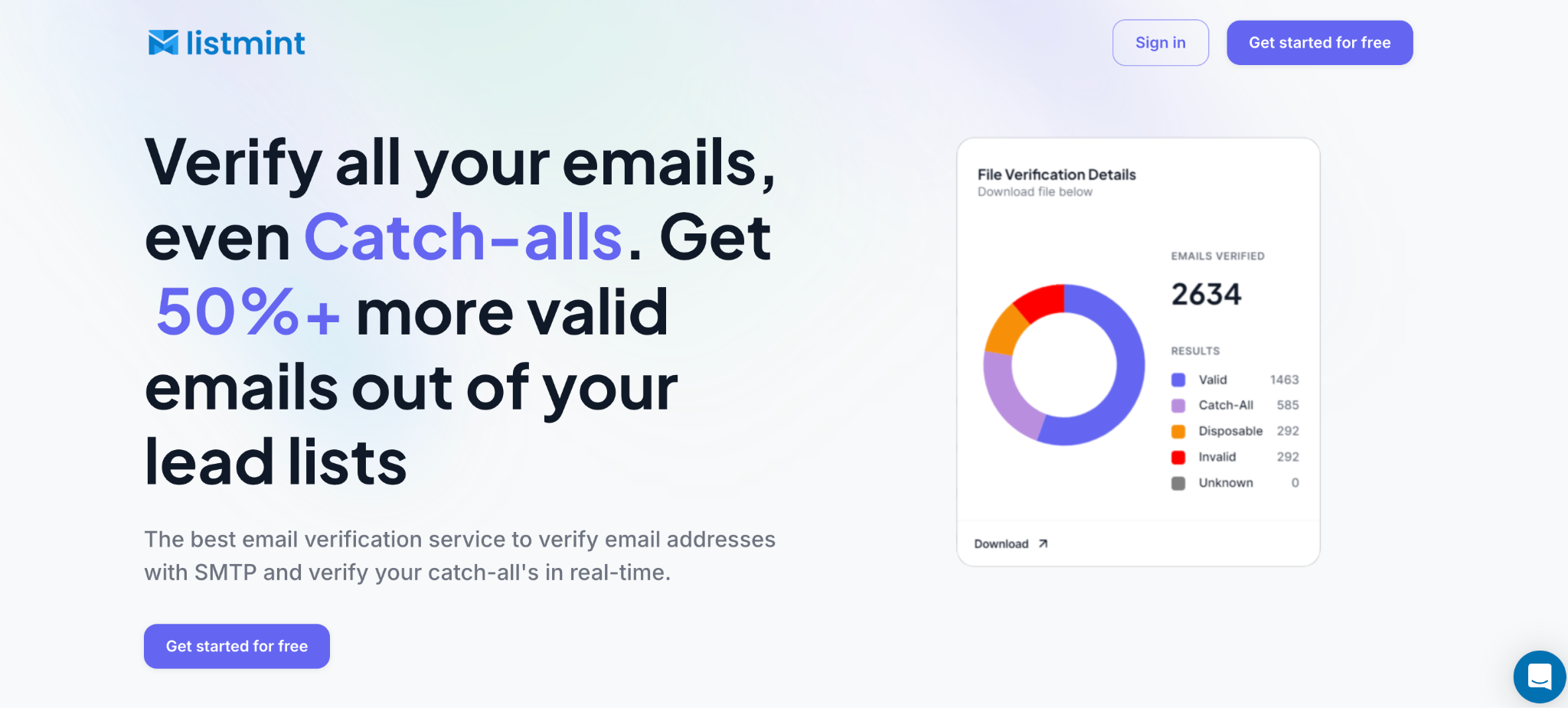
Listmint goes further than a general verifier. Its focus is not just removing bad addresses, but helping teams recover more verified leads from the data they already have without sending blindly.
That makes it useful for outbound teams, agencies, sales ops, and platforms that need to identify real contacts before data reaches a live workflow.
Listmint works for one-time list cleanup, recurring bulk email verification, and API-based verification inside forms, CRMs, and other systems where bad records can spread fast if they are not caught early.
Listmint verifies standard and catch-all addresses in real time without sending emails to the address being checked. This takes verification further than other tools that stop after identifying a domain as catch-all.
Instead of returning only a broad catch-all or risky label, Listmint provides results teams can use to decide what happens next.
In API workflows, those statuses can include valid, invalid, catch_all_valid, and catch_all_invalid. That helps teams decide how to handle each record before it reaches outbound sequences, enrichment flows, or customer systems.
When catch-all domains account for part of a B2B list, this deeper verification can help recover usable contacts that might otherwise remain unresolved. Teams get more information to decide which addresses to keep and which ones to remove before sending.
LeadLoft is an outbound platform that combines prospecting, contact enrichment, email and LinkedIn outreach, and CRM tools in one place. It is built for teams that want to manage leads and outreach without switching between separate systems.

LeadLoft includes email verification through its BounceShield feature as part of its broader prospecting and outreach workflow.
For teams already working inside LeadLoft, verification can happen before contacts move into outreach. The same platform can then be used to manage email and LinkedIn sequences, including cold emails.
Because LeadLoft combines verification with prospecting, enrichment, and CRM features, teams that only need a standalone tool for catch-all email addresses may prefer a dedicated verifier.
CatchAllVerifier is an email verification service focused on catch-all, risky, and unknown email addresses. It is designed for teams and companies that want to run catch-all validation on records that standard verification may not resolve.
CatchAllVerifier analyzes catch-all, risky, and unknown addresses to identify which ones it classifies as valid or invalid.
Teams can upload an email list for bulk verification or use single-email verification to check an individual address in real time. The platform also provides API access, giving teams a way to verify addresses and route the results into custom workflows.
This makes CatchAllVerifier useful for teams that already have risky or unresolved records and want to check them before outreach.
Instantly is an outbound platform built for email marketers and sales teams running campaigns at scale. It combines lead generation, outreach, deliverability tools, CRM features, and email verification in one platform.
Instantly includes catch-all verification as part of its built-in email verification service. Teams can verify leads as they upload them to campaigns, check existing campaign leads, or run verification from the CRM.
Verification results are returned as Valid, Invalid, or Risky. By default, teams don't contact invalid or risky leads, though they can allow risky emails in campaign settings. Instantly’s SuperSearch also runs catch-all verification automatically.
Because verification sits inside the same platform used for outreach, teams can check lead data before sending and manage campaigns without moving between separate tools.
Instantly also provides inbox placement and list cleaning capabilities that support its broader email deliverability workflow.
Kitt AI is a B2B email finder and verifier focused on improving accuracy beyond standard verification methods. It combines SMTP verification with enterprise identity server checks to find and verify email addresses.
Kitt AI adds enterprise identity server checks to its SMTP verification process, giving it another way to evaluate catch-all addresses and identify potential job changes.
These additional checks give Kitt AI another signal for evaluating an address when SMTP verification alone cannot confirm it. They can help determine if an email may belong to the intended contact without relying only on the mail server response.
This approach adds identity-server data to the verification process when standard SMTP checks provide limited information about a catch-all address.
The real work starts after obvious invalid emails are removed. Most tools can detect a catch-all domain, but detection alone does not tell your team if the individual mailbox is valid.
For example, a verifier may label every catch-all address as risky or unknown and stop there. Teams then have to remove those contacts or take the risk of sending to them. Either choice can miss usable leads.
Listmint takes verification further. It verifies catch-all emails and separates them into results teams can act on, including catch_all_valid and catch_all_invalid. That means valid catch-all records can stay in your outreach instead of being discarded simply because of the domain configuration.
That difference becomes valuable when catch-all records make up a significant share of a B2B lead list. Generic verifiers return about 55% valid results. Listmint customers see up to 84% valid results, helping keep more usable contacts in the pipeline instead of leaving them unresolved.
Your team gets more value from the lead data it already has, fewer questionable addresses entering campaigns, and better control over who receives outreach. Listmint turns catch-all results into decisions your team can act on.
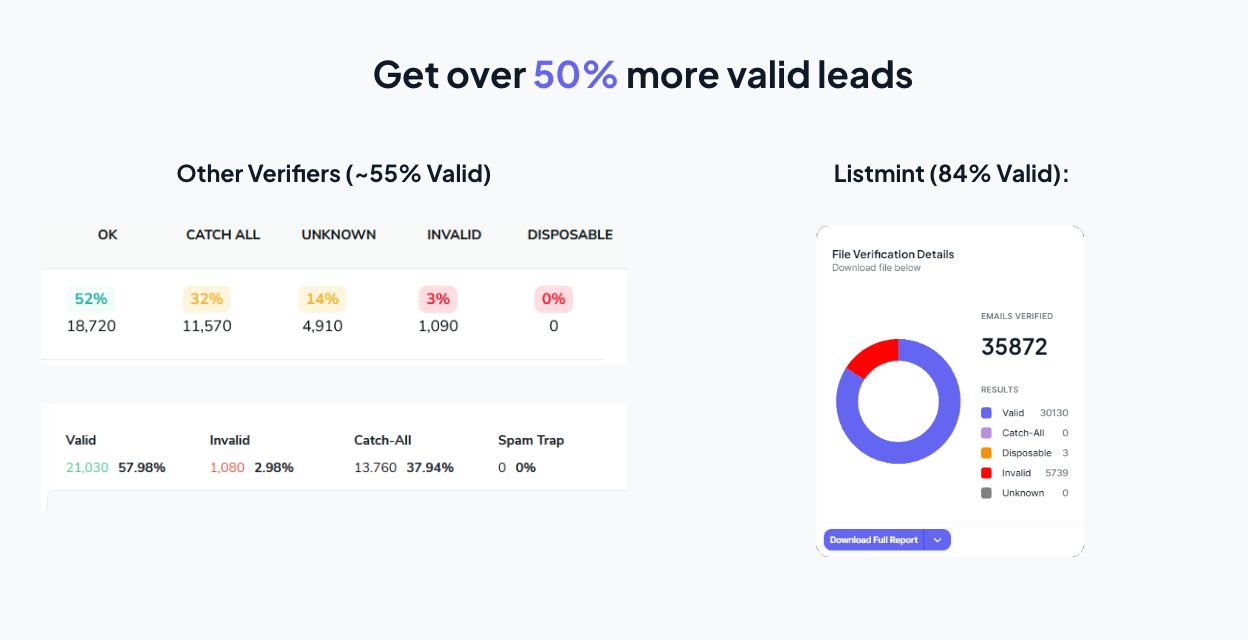
Catch-all records are where a lot of lead list value gets lost. Once they are labeled as risky or unknown, most teams either remove them or treat them with caution.
That approach leaves valid emails unused.
Listmint changes how those records are handled. Catch-all emails are no longer something your team needs to filter out or second-guess. They become part of your usable data.
This has a direct impact on outbound work. More valid emails stay in your list. Fewer contacts are wasted. Campaigns run with less uncertainty.
Catch-all domains are not going away and can remain part of B2B lead data. The difference comes down to how your team handles them before sending.
Better verification leads to better decisions. Better decisions protect every campaign that follows.
Get started for free and test your lead list before your next campaign.
A catch-all domain is configured to accept emails sent to its domain even when the verifier cannot immediately confirm that a specific mailbox exists or belongs to a real person. Catch-all email verification goes further by checking these addresses to determine which ones are more likely to be valid.
The best bulk email verifier depends on your list and verification needs. For companies working with B2B lists that contain catch-all addresses, look for a tool that checks standard and catch-all emails, supports bulk verification, and returns results that are easy to use before outreach.
The best free email verifier is one that lets you test its verification results before paying for higher volumes.
Enterprise domains can be configured to accept messages sent to unknown recipients. When that happens, a standard verification check may receive an accepted response without confirming that the individual mailbox exists.
After verification, keep valid addresses, remove invalid ones, and review any unresolved or risky results before sending. This post-verification step helps prevent questionable addresses from entering an active email campaign.